School of Management
The School of Management brings strong experience in the management sector through teaching, training, and community engagement. Graduates are prepared to operate effectively in public institutions, private enterprises, NGOs, and entrepreneurial ventures, contributing professionally to organizational growth and sustainable development.

At the School of Management Studies, we believe that effective management is a powerful tool for change. Our mission is to empower students with knowledge, skills, and values that enable them to lead with integrity and transform organizations and communities.
Prof.Muna Mudather - Dean of School of Management
About
About the School
The School of Management Studies at Ahfad University for Women is one of the university’s pioneering academic schools. Established in 1977 under the name School of Organizational Management, the school initially awarded a diploma upon completion of four years of study. In line with the university’s commitment to academic excellence and societal needs, the school began awarding bachelor’s degrees in 1984, and by 1991 introduced a five-year program leading to a Bachelor’s Degree with Honors in Management Studies.
Over the years, the School of Management Studies has evolved to reflect changes in the business and organizational environment. Students specialize in Business Administration, Accounting and Finance, or Management Information Systems (MIS)—the latter introduced in 2005 to replace Office Management. In 2015, the University Academic Board further strengthened the Business Administration program by approving three focused concentrations: Human Resource Management, Marketing Management, and Procurement and Supply Chain Management. Through these programs, the school prepares graduates with strong managerial, analytical, and leadership skills to meet the demands of modern organizations and contribute effectively to sustainable development.
Vision
To become an international, well-recognized management school, known for excellence in
education, research, and community development.
Mission
SMS is committed to provide up-to-date, analytical and career-oriented academic programs; offer superb teaching and research environment to students and faculty and; strengthen the public engagement programs of the University so as to provide purposeful, entrepreneurial, and innovative talents.
Experience in Management Sector
With decades of academic and practical engagement, the School of Management Studies at Ahfad University for Women brings strong experience in the management sector through teaching, training, and community engagement. The school integrates theory with real-world practice, equipping students with hands-on skills in leadership, planning, finance, human resources, marketing, and supply chain management. Graduates are prepared to operate effectively in public institutions, private enterprises, NGOs, and entrepreneurial ventures, contributing professionally to organizational growth and sustainable development.
Staff

Prof.Ahmed Hassan El Jack
PhD, University of California, Los Angeles, U.S.A., 1969, Professor.

Prof. Amna El Sadig Badri
PhD, University of Khartoum, 1987, Professor.

El Tahir Omer Khalid Medani
PhD, University of Khartoum, 2005, Associate Professor.

Fatima Abdelkareem Mohamed Badri
PhD, University of Liverpool, 1991, Associate Professor.
Madani Adam Madani
PhD, University of Khartoum, 1999, Associate Professor.

Sumaia Mohamed El Zein Ahmed Badawi
PhD, University of Khartoum, 2002, Associate Professor.
Widad Ali A/Rahman
PhD, Ahfad University for Women, 2006, Associate Professor.
Yassir Abbas Saeed Abbas
PhD, Economics, University of Khartoum, 2004, Assistant Professor.
Amel Abdalla Merghani Mohamed Ali
MSc, University of Science and Technology, 2008, Lecturer.
Fayhaa Mohamed El NourBabiker
MSc., Computer Sciences, Elneileen University 2015, Lecturer.
Undergraduate Programs
Curriculum
The School of Management Studies at Ahfad University for Women offers a six-year Bachelor of Science (Honors) degree program. The first year serves as a preparatory English language program, followed by five years of specialized management studies. The curriculum includes five specializations: Accounting and Finance, Management Information Systems, Business Administration ( Human Resources Management, Marketing Management, and Procurement & Supply Chain Management). The curriculum follows the semester system, with two semesters per academic year. In accordance with university regulations, each semester is treated independently in terms of course delivery, assessment, and evaluation of results.
Degree Requirements /Curriculum Outline
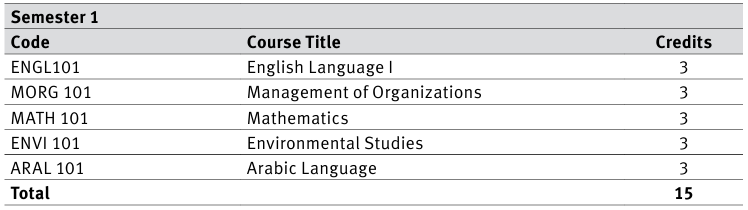
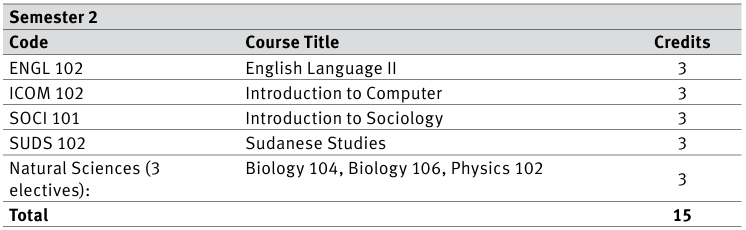
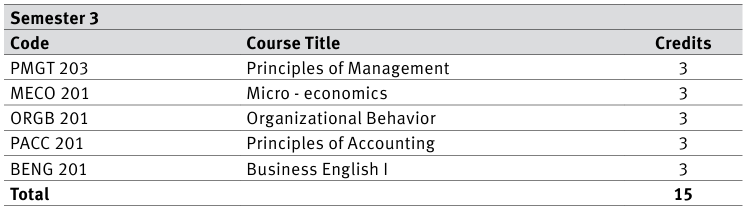
Accounting and finance Curriculum
Semester 1
Semester 2
Semester 3
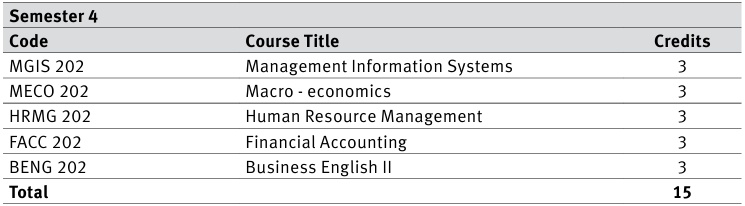
Semester 4
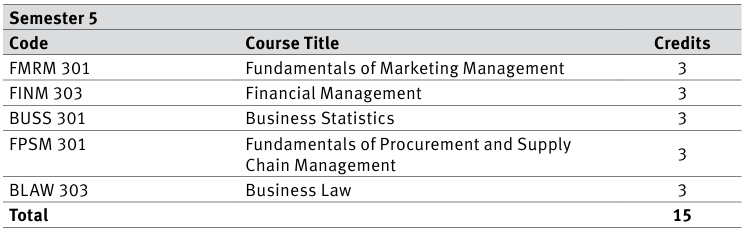
Semester 5
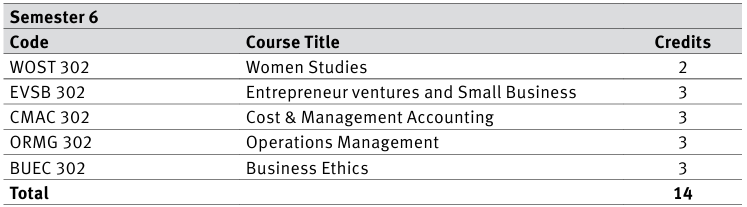
Semester 6
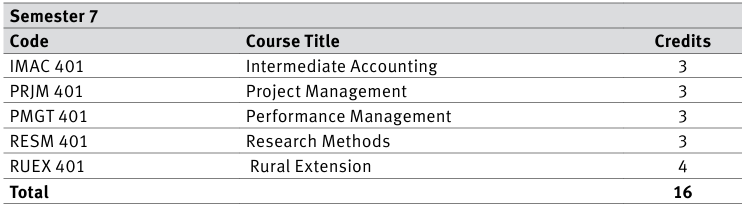
Semester 7
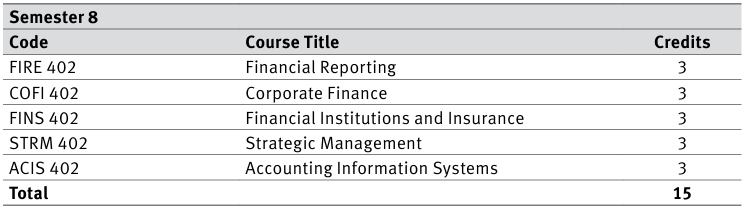
Semester 8
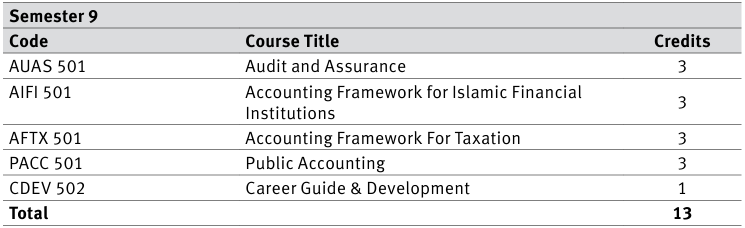
Semester 9
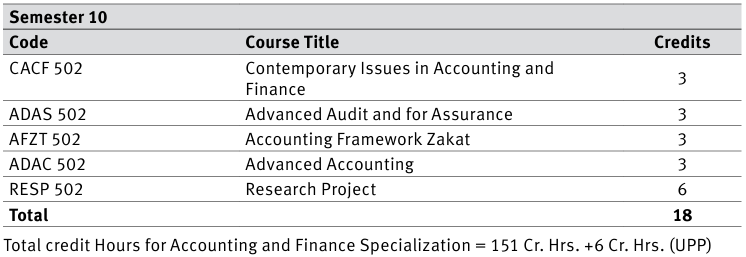
Semester 10
Management Information System Curriculum
Semester 1
Semester 2
Semester 3
Semester 4
Semester 5
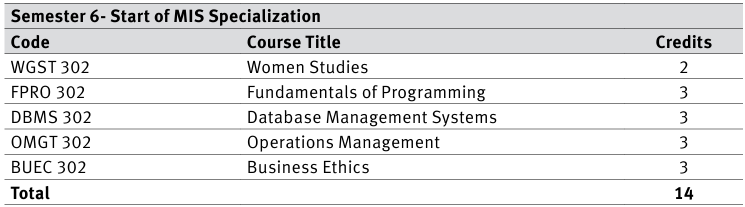
Semester 6
Semester 7
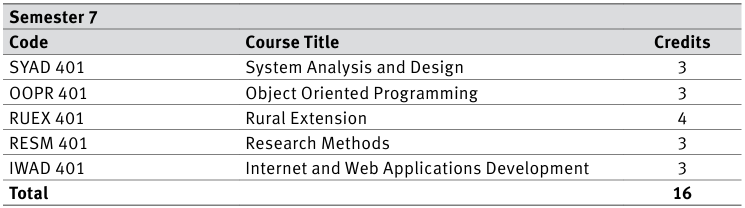
Semester 8
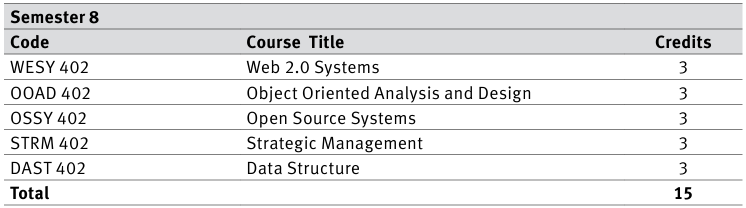
Semester 9
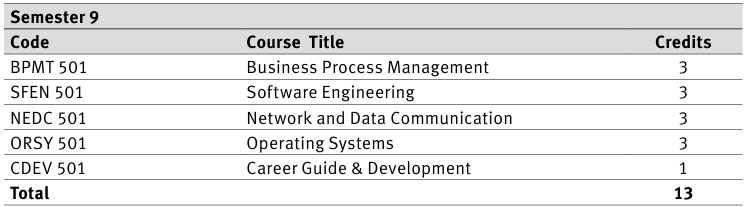
Semester 10
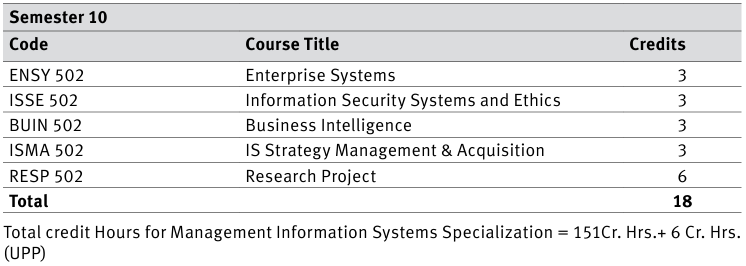
Human Resource Management Curriculum
Semester 1
Semester 2
Semester 3
Semester 4
Semester 5
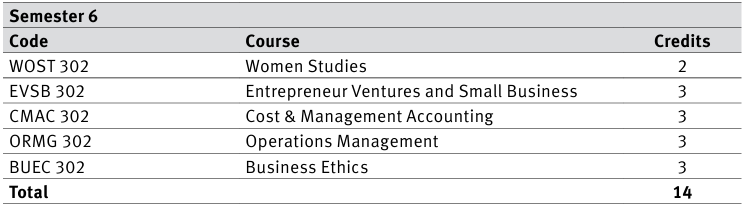
Semester 6
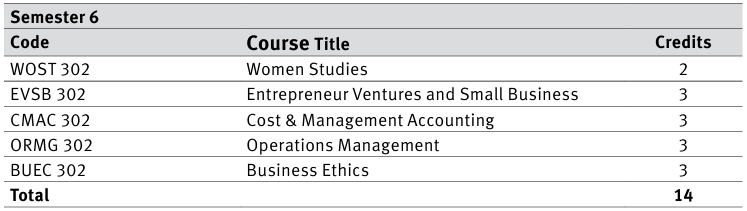
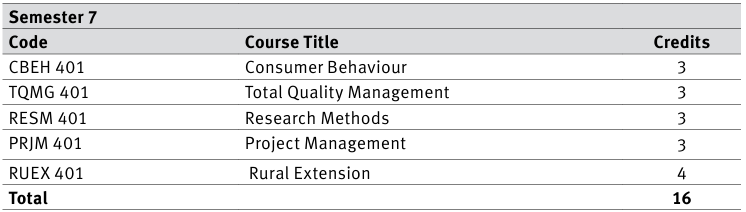
Semester 7
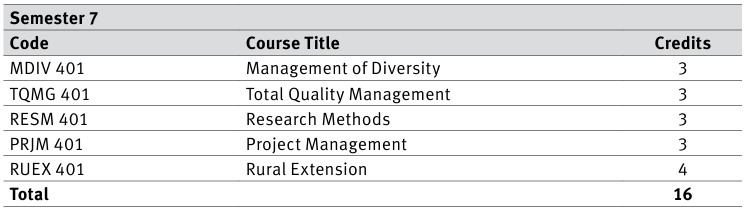
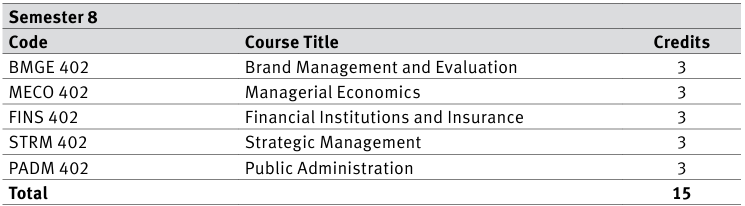
Semester 8
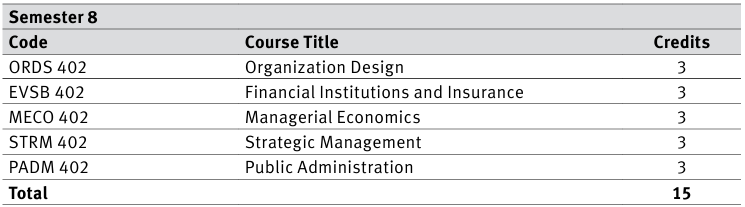
Semester 9
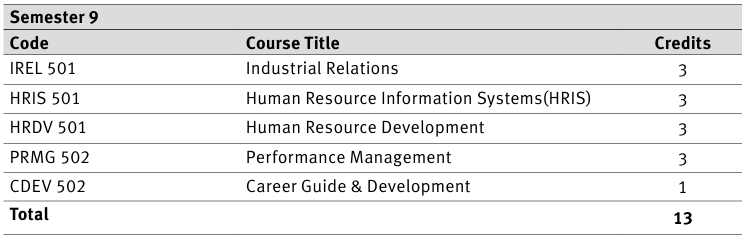
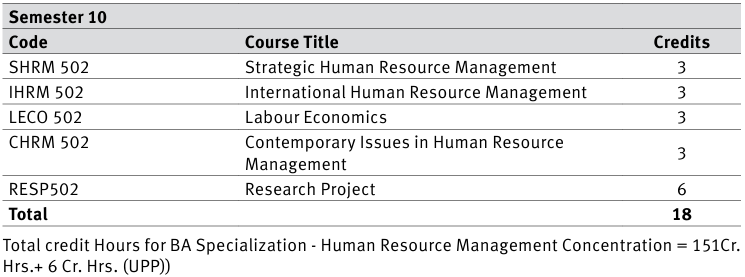
Semester 10
Marketing Management Curriculum
Semester 1
Semester 2
Semester 3
Semester 4
Semester 5
Semester 6
Semester 7
Semester 8
Semester 9
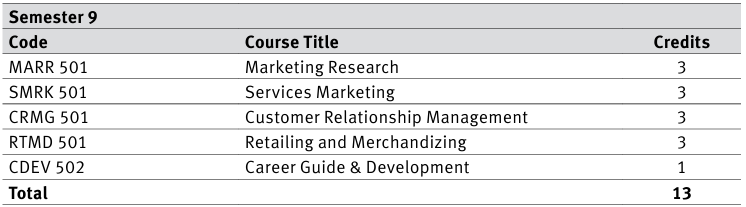
Semester 10
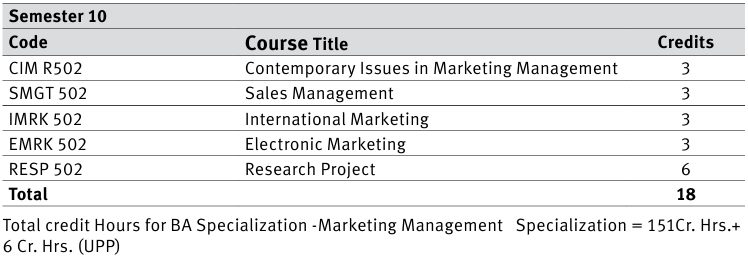
Procurement and Supply Chain Management Curriculum
Semester 1
Semester 2
Semester 3
Semester 4
Semester 5
Semester 6
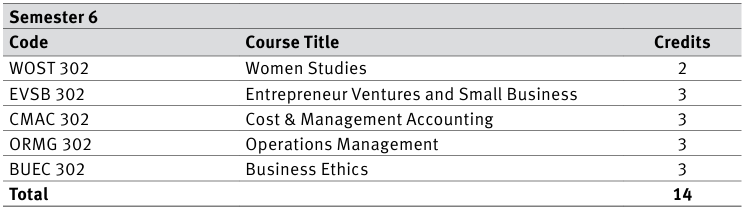
Semester 7
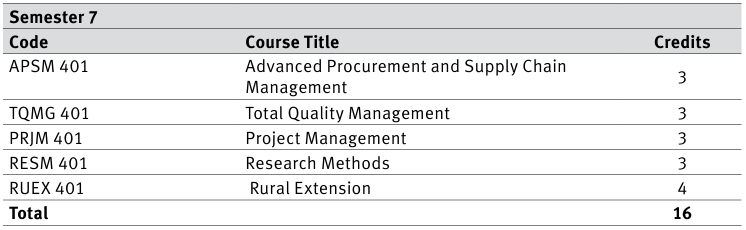
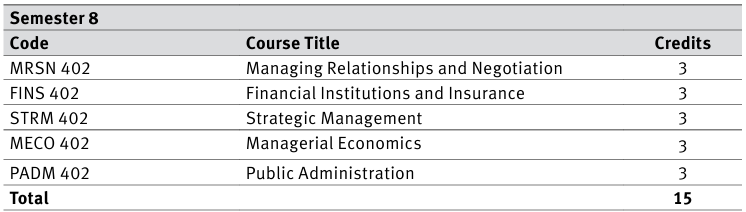
Semester 8
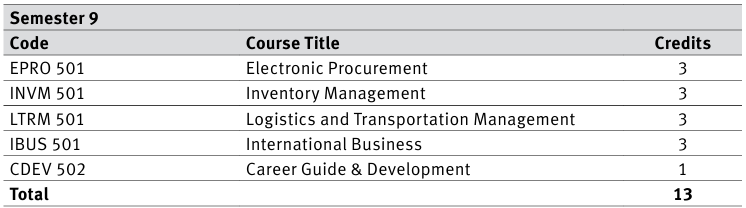
Semester 9
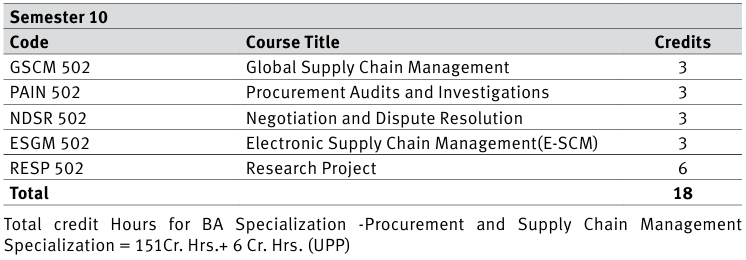
Semester 10
Course Descriptions
Common Courses
ICOM 101 Introduction to Computer 3 cr.
This course has a practical orientation towards computer rather than purely academic. The academic component covers basic hardware and software terminology. The practical component of the course enables students to tackle day to day problems in using computer in a work environment. The course also provides students with knowledge and experience in using internet application and searching techniques. The course enables the students to design and use PowerPoint presentations along with other essential working skills.
PMGT 203 Principles of Management 3 cr.
This course intends to expose the students to the basics of management. The course starts with providing students with a brief historical development of management thought as a science and profession. Then the students will be exposed to the details of the operational management approach. Prerequisite: MORG 101.
PACC 201 Principles of Accounting 3 cr.
This course aims to provide the students with a conceptual understanding of the main accounting concepts, analysis of accounting transactions, elements of accounting, and the preparation of the basic financial statements.
FACC 202 Financial Accounting 3 cr.
This course aims to provide the students with a conceptual understanding of the use and control of information contained in the financial statements and allows them to produce that information for business decision – making purposes. Prerequisite: PACC 201.
FINM 301 Financial Management 3 cr.
This course explains the tools that determine and analyze the major decisions a financial manager has to make, including identification of the firm’s goals, time value of money, use of discount cash flow models, capital budgeting under certainty, capital structure as it relates to
cost of capital, dividend policy, and ethics in finance.
MGIS 202 Management Information Systems 3 cr.
This course provides an introduction to management information system (MIS) for the undergraduate studies. Students will examine the role of information system in supporting a wide range of organization functions and the use of information systems in supporting administrative operation, decision making, overall strategic initiative and corporate philosophy. The course helps students to see the connection between business and the use of information and communication technology (ICT) by individuals and organizations within the business environment. Prerequisite: ICOM 102.
CMAC 302 Cost and Management Accounting 3 cr.
This course gives students the required skills for using accounting as managerial tool in the process of decision making. It covers management and cost accounting, and profile measurement. Prerequisite: PACC 201.
MECO 201 Micro-economics 3 cr.
The purpose of this course is to present clear and accurate introduction to principles of micro economics and to connect micro economic theories with the world around, mainly the business cycle. Prerequisite: SOCI 101.
MECO 202 Macro-economics 3 cr.
The purpose of this course is to provide the students with an in depth knowledge in macroeconomics such as the way economists measure national output and income and different macro polices such as fiscal and monetary policies. Prerequisite: MECO 202.
HRMG 202 Human Resource Management 3 cr.
This course is intended to familiarize students with the principles of managing human resource of an enterprises. Prerequisite: PMGT 203.
FMRM 301 Fundamentals of Marketing 3 cr.
This course introduces the students to the basic concepts of marketing and how to relate them to business. It explains the core concepts of marketing; and marketing management. Prerequisite: PMGT 203.
BUSS 301 Business Statistics 3 cr.
The course is designed to give an introduction to the basic statistical techniques for descriptive data analysis and to show how these techniques are useful as an aid in the decision making process. Prerequisite: MATH 101.
FPSM 301 Fundamentals of Procurement and Supply Chain Management 3 cr.
This course provides students with an overview of the fundamentals of procurement and supply chain management by tracing the historical developments of the discipline, identifying fundamental concepts and principles of the discipline. It will also provide an overview of the operation, distribution, and integration issues in procurement and supply chain management. Prerequisite: PMGT 203.
BLAW 303 Business Law 3cr.
This course provides students with the awareness of legal issues that arise in business management. It gives students a general background in the different legal aspects that surround a business. Prerequisite: PMGT 203.
ORGB 2O3 Organizational Behavior 3 cr.
This course introduces students to the study of organizational behavior, focusing on the employees’ behavior at the individual and group levels, and its consequences on performance. It introduces students to theories of motivation, group formation, their types, conflicts,
and passing through the organization processes, theories of leadership, organizational development, Socialization process and decision making. Prerequisite: PMGT 203.
BENG 201 Business English I 3 cr.
This course aims at developing student’s language competence. The course aims at exposing the students to vocabulary and texts used in business and allows student to analyze the business texts to understand their structure and usability. Prerequisites: ENGL 101 and ENGL 102.
BENG 202 Business English II 3 cr.
This course aims at mastering the language required for the study of business. The course is designed to provide the student with the necessary competencies of reading writing and comprehending the business documents in addition to developing the student’s skills in
communicating a comprehensible and coherent business presentation. Prerequisite: BENG 201.
Accounting & Finance Major
IMAC 401 Intermediate Accounting 3 cr.
Intermediate Accounting is the study of accounting principles and procedures essential to the preparation of financial statements with particular emphasis on the corporate form. Topics of coverage include financial statements, current assets, inventory, property, plant, and
equipment, cash and receivables, current and long-term liabilities and stockholder’s equity. Prerequisite: PACC 201.
ACIS 401 Accounting Information Systems 3 cr.
A course that explores in detail several typical Accounting Information System (AIS) application
subsystems, such as order entry/sales, billing/receivables/cash receipts, inventory, purchasing/ accounts payable/cash disbursements, payroll, and materials planning/ production. This course includes understanding, documenting, designing, using, and auditing these application subsystems. Business majors only. Prerequisite: IMAC 401.
PMGT 401 Performance Management 3 cr.
This course introduces the elements of management accounting which are used to make and support decisions by introducing the nature, the source and purpose of cost accounting and the costing techniques used in business which are essential for any management accountant. The course looks at the preparation and use of budgeting and standard costing and variance analysis as essential tools for planning and controlling business cost, and also concludes with an introduction to measuring and monitoring the performance of an organization. Prerequisite: FACC 202.
FIRE 402 Financial Reporting 3 cr.
This course covers current practices in corporate financial reporting and fundamental issues relating to asset valuation and revenue determination. The emphasis is on financial statement analysis and interpretation of financial disclosures to help improve risk assessment, forecasting, and decision-making. However, the course covers some selected issue including; lease, foreign exchange rates, government grants and special contracts. Prerequisite: FINM 301.
COFI 402 Corporate Finance 3 cr.
This course enables the students to understand different financial issues and concepts necessary for managerial decision making. It covers topics of Common Stock, Investment under uncertainty, Term Loans, Cost of Capital and Dividend Policy. Prerequisite: FINM 301.
AUAS 501 Audit and Assurance 3 cr.
The course examines the principles and practices of internal and external auditing. Topics include auditing as a component of recurrent and strategic activities, risk assessment, internal control, systems evaluation, evaluation of evidence, audit planning and contemporary audit
issues and challenges. Prerequisite: FACC 202.
AIFI 501 Accounting Framework for Islamic Financial Institutions 3 cr.
This course develops knowledge and skills in understanding and applying Islamic finance and Islamic standards and the theoretical framework in the preparation of financial statements of Islamic institutions. Prerequisite: FINS 402.
AFTX 501 Accounting Framework for Taxation 3 cr.
This course attempts to develop the knowledge and skills related to the tax system as applicable to individuals and companies in Sudan. It acquaints students with the operating taxation system and its computations, as well as its different types. Prerequisite: CMAC 302.
PACC 501 Public Accounting 3 cr.
The course aims to familiarize students with Government Accounting, budget process/ preparation, budget estimation methods and final accounts and to understand the difference between business & non-business organization and the use of cash & accrual basis & modified
accrual bases in government accounting. Prerequisite: FACC 202.
ADAS 502 Advanced Audit and Assurance 3 cr.
This course applies auditing principles to audit situations. It introduces audit practices and research theory issues. It discusses financial auditing issues from the perspectives of management, accountants, internal auditors, audit committees and external auditors. This course also applies relevant knowledge, skills, and exercise professional judgment in analyzing, evaluating, concluding and reporting on the assurance engagement and other audit. Prerequisite: AUAS 501.
AFZT 502 Accounting Framework For Zakat 3 cr.
This course attempts to develop the knowledge and skills related to the Zakat system as applicable to individuals and companies in Sudan. It acquaints students with the operating Zakat system and its computations, as well as its different types. Prerequisite: FACC 202.
ADAC 502 Advanced Accounting 3 cr.
The main objective of this course is to give students knowledge about published accounts by using (IFRS) international financial reporting standards and about (IAS) international accounting standards. Prerequisite: PACC 501.
EVSB 402 Entrepreneur Ventures and Small Business 3 cr.
This course focuses on the founding and development of new business organizations. The course is oriented toward principles needed to operate a small business and fundamentals of business management, including planning, raising capital, using business information, managing employees, and marketing products and services. The goal is to provide a comprehensive background with practical application of important concepts applicable to small business and entrepreneurial environment. Prerequisite: PMGT 203.
FINS 402 Financial Institutions and Insurance 3 cr.
This course provides students with overview of the different financial institutions, the course also introduce student to the basic knowledge and application of insurance elements and principles with special focus on its practice in Sudan. Prerequisite: FINM 301.
BUEC 402 Business Ethics 3 cr.
This is an introductory course that provides students with an overview of business ethics at the individual and organizational. Ultimately, the course is designed to not only introduce students to a wide array of current ethical issues in business but to also foster skills related to critically analyzing the ethical and social dimensions of business-related problems in order to build more ethically-informed rationales for decision making. Prerequisite: PMGT 203.
CICF 503 Contemporary Issues in Accounting and Finance 3 cr.
This course deals with special current issues and concerns in accounting and finance which are not included in regular courses.
Management Information System Major
FPRO 302 Fundamentals of Programming 3 cr.
This course introduces the student to the main paradigms of computation, representative languages of these paradigms, techniques of implementing various programming language constructs, as well as basic concepts relating to the specification of programming languages.
Syntax and semantics of programming languages, basic constructs that are common to all languages (control structures, subprograms, etc.) will be covered. The intent of the course is to use a specific programming language; to exemplify the main concepts and constructs. Prerequisite : ICOM 102.
DBMS 302 Database Management Systems 3 cr.
This course provides students with an in-depth understanding of the design and implementation of database systems. Prerequisite : ICOM 102.
SYAD 401 System Analysis and Design 3 cr.
Students will learn how to gather user requirement of new information system and transfer it to information system models. What is the life-cycle approach to analysis and Design and what makes it very effective? What issues comes up in Analysis and Design? Students will use Data Flow Diagram for analysis and Design. Prerequisite : DBMS 302.
NEDC 501 Network and Data Communication 3 cr.
This course provides an overview of Network and Data communication and a detailed, practical understanding of selected aspects, including computer networks and data communication and telecommunication networks. The course will be relevant to those working in an organization concerned, directly or indirectly, with valuable information assets. Prerequisite: IWAD 401.
BPMT 501 Business Process Management 3 cr.
This course presents the concepts and state of the art / state of the practice of business process design and business process reengineering for improving business performance, effectiveness, quality, customer service and satisfaction. Issues related to characteristics, goals, benefits and costs of enterprise-wide design, and the role of information technology during the design process will be discussed. The course leads students from process discovery through conceptual and technical process design through the implementation and management of workflows to the structure of process-aware information systems. Prerequisite: MGIS 202.
OOPR 401 Object Oriented Programming 3 cr.
This course presents a conceptual and practical introduction to imperative and object oriented programming, exemplified by Java. As well as providing a grounding in the use of developing information systems, the course will cover general principles of programming in imperative and object oriented frameworks. The course enable you to develop programs that support and solve the business problems. Prerequisite: FPRO 302.
OOAD 402 Object Oriented Analysis and Design 3 cr.
This course aims to convey the basics of systems analysis and design and how businesses use information systems to support their business processes; provide knowledge and skills about the methods of analyzing and designing systems tailored to business requirements; and familiarize students with modelling techniques and the design of solutions for information system using Unified Modelling Language (UML). Prerequisite : OOAD 402.
ISMA 502 IS Strategy Management &Acquisition 3 cr.
This course explores the issues and approaches in managing the information systems function in organizations and how the IS function integrates / supports / enables various types of organizational capabilities. It takes a senior management perspective in exploring the acquisition, development and implementation of plans and policies to achieve efficient and effective information systems. The remainder of the course is focused on developing an intellectual framework that will allow leaders of organizations to critically assess existing IS infrastructures and emerging technologies as well as how these enabling technologies might affect organizational strategy. Prerequisite: MGIS 202.
IWAD 401 Internet and Web Applications Development 3 cr.
This course is designed to equip the student with theoretical and practical knowledge about the process of conceptualization, planning, modeling, and execution of electronic media content delivery mechanism via the internet. Prerequisite: MGIS 202.
WESY 402 Web 2.0 Systems 3 cr.
The course focuses on new media, new technologies in new media, and web of the second generation. Emphasis is put on new trends in web applications architecture and their practical use. This course will bring a new wave of exciting websites and technologies into the Web 2.0 era, rich and interactive forms of communication, collaboration, and socialization are the heartof Web 2.0. Prerequisite: IWAD 202.
SFEN 501 Software Engineering 3 cr.
Software Engineering is the application of a systematic, disciplined, quantifiable approach to the development, operation, and maintenance of software. It encompasses techniques and procedures, often regulated by a software development process, with the purpose of improving the reliability and maintainability of software systems. The effort is necessitated by the potential complexity of those systems, which may contain millions of lines of code. Prerequisite: SYAD 401.
DAST 402 Data Structure 3 cr.
The purpose of this course is to provide the students with solid foundations in the basic concepts of programming: data structures and algorithms. The main objective of the course is to teach the students how to select and design data structures and algorithms that are appropriate for problems that they might encounter This course is also about showing the correctness of algorithms and studying their computational complexities. This course offers the students a mixture of theoretical knowledge and practical experience. Prerequisite: FPRO 302.
OSSY 402 Open Source Systems 3 cr.
This course introduces students to the technological, social, and pragmatic aspects of developing open source software through direct involvement in a real open source project/ projects. Students will learn to use the tools, techniques, and strategies of OS developers.
This is a project-based programming course. The particular open source project(s) to be studied will vary with each offering and be announced at the beginning of the semester. Prerequisite: FPRO 302.
ENSY 502 Enterprise Systems 3 cr.
This course introduces the students to the lifecycle of enterprise systems including the development, the implementation, use and evaluation involves company external entities (e.g. software vendors or consulting companies) as well as company internal entities (e.g.IT
departments and end-users). Prerequisite: MGIS 202.
ISSE 502 Information Security Systems and Ethics 3 cr.
This course provides an overview of information security and a detailed, practical understanding of selected aspects, including IT governance and information security risk analysis and management. The course will be relevant to those working in an organization concerned, directly or indirectly, with valuable information assets. Prerequisite: NEDC 501.
BUIN 502 Business Intelligence 3 cr.
Business Intelligence provides students with a solid foundation of BI that is reinforced with hands-on practice through the features of the updated information on data mining, text and web mining, and implementation and emerging technologies. This course takes a managerial
approach to Business Intelligence (BI), emphasizing the applications and implementations behind the concepts. Prerequisite: DBMS 302.
ORSY 501 Operating Systems 3 cr.
Operating systems provide a software interface to make the hardware of a computer more readily usable, and to provide cost-effective use of that hardware. This course covers how key aspects of operating systems can be implemented, including process scheduling, memory management, file systems, and input/output. In addition, the history of operating systems will be discussed and how they have developed in line with advances in hardware. Prerequisite: FPRO 302.
BUEC 402 Business Ethics 3 cr.
This is an introductory course that provides students with an overview of business ethics at the individual and organizational. Ultimately, the course is designed to not only introduce students to a wide array of current ethical issues in business but to also foster skills related to critically analyzing the ethical and social dimensions of business-related problems in order to build more ethically-informed rationales for decision making. Prerequisite: PMGT 203
Business Administration Specialization Majors
ORMG 302 Operations Management 3 cr.
This course introduces students to the fundamental principles of operations management in both manufacturing and service sectors. Prerequisite: BUSS 301.
MDIV 401 Management of Diversity 3 cr.
This course provides a multidisciplinary approach to the organizational and leadership challenges encountered by individuals, groups, managers and organizations as they strive to successfully compete for talented workers in an increasingly diverse labor market. Also, this
course enables students to practically apply theory to develop positive workplace diversity practices. Prerequisite: HRMG 202.
TQMG 401 Total Quality Management 3 cr.
This course provides the ingredients of the total quality management system, stressing the major management initiatives which should be undertaken: employee involvement, measurement of quality, preventive management, leadership, and management of change to ensure quality performance. Prerequisite: PMGT 203.
RESM 401 Research Methods 3 cr.
This course lays the theoretical foundations for research methods and is designed to equip students with knowledge and skills for conducting scientific research. Different aspects of methodological research approaches are discussed. Quantitative and qualitative research methodologies are dealt with, and the various steps of conducting research such as problem identification, sampling techniques, data collection tools, data analysis and writing up of research project are also explained.
PRJM 402 Project Management 3 cr.
This course identifies projects and project management and highlights the main types and characteristics of project management as compared to general management. It also shows how projects are planned, organized, financed and implemented with focus on the project
life-cycle. Monitoring and control, evaluation and sustainability of projects are also tackled. Prerequisite: PMGT 203.
ORDS 402 Organization Design 3 cr.
This course is intended to increase student understanding of the nature and purpose of organizations and how and why approaches to organization design change. Organization structure, processes, effectiveness, and the impact on individual member development and stakeholder expectations will be the major focal points of the course. Prerequisite: HRMG 202.
EVSB 402 Entrepreneur Ventures and Small Business 3 cr.
This course focuses on the founding and development of new business organizations. The course is oriented toward principles needed to operate a small business and fundamentals of business management, including planning, raising capital, using business information, managing employees, and marketing products and services. The goal is to provide a comprehensive background with practical application of important concepts applicable to small business and entrepreneurial environment. Prerequisite: PMGT 203.
MECO 402 Managerial Economics 3 cr.
The purpose of this course is to provide the students with an introduction knowledge in managerial economics; it explains how economic concepts and decision science tools and techniques can be used in optimal decision problem facing managers.
STRM 402 Strategic Management 3 cr.
This course provides students with the knowledge and skills of applying different strategies of management planning. It covers the stages of the strategic management process Prerequisite: PMGT 203.
BUEC 402 Business Ethics 3 cr.
This is an introductory course that provides students with an overview of business ethics at the individual and organizational. Ultimately, the course is designed to not only introduce students to a wide array of current ethical issues in business but to also foster skills related to critically analyzing the ethical and social dimensions of business-related problems in order to build more ethically-informed rationales for decision making. Prerequisite: PMGT 203.
IREL 501 Industrial Relations 3 cr.
This course introduces students to the theories, institutions and practices of industrial relations. The module examines the role and objectives of the main actors in the employment relations: employers, employees, and trade unions and the government; and their interactions in collective bargaining, employee involvement/ participation, conflict resolution and expression and the termination of the employment relationship. Prerequisite: HRMG 202.
HRIS 501 Human Resource Information Systems (HRIS) 3 cr.
This course is intended to help students to plan, design, and implement an HRIS. A more thorough understanding of requirements and alternatives leads to more successful and flexible HR systems. Students will be able to look at the best ways to create that understanding by
combining the technical and functional foundations for students to understand HR management information systems that compose an organization’s HRIS technology infrastructure. Prerequisite: HRMG 202.
HRDV 501 HRMG 202 3 cr.
This course is designed to expose students to employee training and development within an organization. Specifically, it is designed to help students develop skills that will enable them to effectively design, implement, and evaluate training systems from an applied perspective.
The course also sheds light on career planning and development as essential functions in maintaining competency, motivation, and commitment. Prerequisite: HRMG 202.
PRMG 502 Performance Management 3 cr.
This course examines the importance of an effective performance management system in helping organizations define and achieve short and long term goals. It explains the concept that performance management is not a one-time supervisory event, but an ongoing process
of planning, facilitating, assessing, and improving individual and organizational performance. In addition, the course emphasizes the importance of measuring the effectiveness of human resource activities that are designed to enhance individual and organizational performance. Prerequisite: HRMG 202.
SHRM 502 Strategic Human Resource Management 3 cr.
This course is designed to provide students with an understanding of the fundamental principles and practices of strategic human resource management. Students will be introduced to key frameworks, theories, and constructs in the field. We will examine how modern human resource practices can increase both employee well-being and organizational effectiveness
and competiveness. Prerequisite: HRMG 202.
IHRM 502 International Human Resource Management 3 cr.
This course provides an understanding of the role of human resource management (HRM) in international contexts. The course is divided into three areas of study: the context of international HRM, strategic and functional HRM in international contexts, and comparative international contexts. Prerequisite: HRMG 202.
LECO 502 Labor Economics 3 cr.
The important concern of this course as a field of study is with investigating and showing the importance of labor economics as a spate discipline, also to know the historical development in the study of labour economics, the theoretical approach, supply and demand of labour,
application of the different models, investment of human capital, determinates of labor demand in the short run and long run. Prerequisite: HRMG 202.
CHRM 502 Contemporary Issues in Human Resource Management 3 cr.
This course examines current issues in human resource management (HRM) through readings, case studies and dialogue based on relevant theory and research in areas such as linking HRM to business performance, key general principles in managing people, and managing people
in dynamic and complex situations such as today’s global environment. In addition, students complete an independent study project approved by the instructor. Prerequisite: HRMG 202.
CBEH 401 Consumer Behavior 3 cr.
This course focuses on customers as the key to market success. Topics covered include the roles of a customer, market values a customer seeks, determinants of customer behavior, the customer’s mind set, customer decision-making, and customer-focused marketing. Prerequisite: FMRM 301.
BMGE 402 Brand Management and Evaluation 3 cr.
This course is designed to develop the necessary knowledge and skills for creating and managing brands which resonate with customers and allow the marketing organization to build and maintain a loyal and profitable customer base. A range of branding theories, concepts,
strategies and practices designed to build, measure and sustain brand will be addressed across a range of real world contexts, product types and industries. Prerequisite: FMRM 301.
MARR 501 Marketing Research 3 cr.
A course that provides thorough coverage of various marketing research tools along an applied orientation, including a systematic analysis of the steps comprising the marketing research process, starting with research problem definition and terminating with data collection,
analysis, and presentation. Prerequisite: FMRM 301.
SMRK 501 Services Marketing 3 cr.
This course includes a study of the characteristics of services and their marketing implications, developing marketing strategies, creating value, pricing and promoting the service performance, and ensuring a positive customer experience. Prerequisite: CBEH 401.
CRMG 501 Customer Relationship Management 3 cr.
This course defines Customer Relationship Management CRM as core business strategy that integrates internal processes and functions and external networks to create and deliver value to targeted customers at a profit. Also, this course introduces the current developments in
(CRM), apply current CRM tools and methodologies and understand the link between CRM and a company’s marketing performance. Prerequisite: FMRM 301.
RTMD 501 Retailing and Merchandizing 3 cr.
This course examines the opportunities and problems faced by marketers in contemporary retail formats. The course allows students to develop appropriate skills and knowledge for effective and efficient decision making in the contemporary retail environment. Prerequisite: FMRM 301.
CIMR 502 Contemporary Issues in Marketing 3 cr.
This course deals with special current issues and concerns in marketing which are not included in regular courses. Prerequisite: FMRM 301.
SMGT 502 Sales Management 3 cr.
An overview of selling and sales management. Topics covered include sales management functions and strategies, developing the selling function, sales goals and structure, building a sales program, and leading and motivating the sales force. Prerequisite: RTMD 501.
IMRK 502 International Marketing 3 cr.
This course provides students the relevant knowledge to understand the international marketing strategies and to develop the awareness about environmental factors that influence international marketing. The course also provides students full details about the 4Ps at the
global scale, as well as global organization structures. Prerequisite: FMRM 301.
EMRK 502 Electronic Marketing 3 cr.
An overview of electronic marketing development and its impact on marketing transactions and management of organizations. Topics covered include business to business and business to consumer e-commerce and e-marketing; management of an e-marketing project; and financial, legal, and security issues. Prerequisite: FMRM 301.
APSM 401 Advanced Procurement and Supply Chain Management 3 cr.
This course covers the entire procurement and supply chain process. It is intended to enable the students to link the stages in the procurement and supply chain processes. Prerequisite: FPSM 301.
MRSN 402 Managing Relationships and Negotiation 3 cr.
This course examines how to create effective relationships in procurement and supply chains. Prerequisite: FPSM 301.
EPRO 501 Electronic Procurement 3 cr.
This course provides students with fundamental principles and practices of electronic procurement. Prerequisite: APSM 401.
INVM 501 Inventory Management 3 cr.
Inventory control concepts, techniques, and strategies for effective integration with basic finance, marketing, and manufacturing objectives are topics covered in this course. Models for dependent and independent demand inventory systems, material requirements planning systems, distribution requirements, planning techniques, and the classical reorder point inventory model are also included. Prerequisite: FPSM 301.
LTRM 501 Logistics and Transportation Management 3 cr.
The course covers all aspects of logistics management, from theories to strategies and operational guidelines. The course focuses on analyzing managerial decisions related to the movement and storage of supplies, work-in-process, and finished goods, examining the trade
offs encountered by managers such as level and modes of transportation used, warehousing and control of inventory levels, demand management and forecasting master production scheduling, and importance of logistics to the overall productivity of a firm are investigated. Prerequisite: FPSM 301.
GSCM 502 Global Supply Chain Management 3 cr.
This course deals with the unique requirements in the globalization of supply chains such as the deployment of best practices of world-class operations, writing of an effective memo and term paper as well as present technical information. Prerequisite: APSM 401.
PAIN 502 Procurement Audits and Investigations 3 cr.
This course provides students with the principles and practices of procurement audits and investigations. Prerequisite: APSM 401.
NDSR 502 Negotiation and Dispute Resolution 3 cr.
This course examines both theoretical and practical implications of diverse assumptions and strategies. Students develop a deeper self-awareness of their role in the creation, perpetuation, escalation and resolution of conflicts, as well as in relationship with the other party. Prerequisite: APSM 401.
ESGM 502 Electronic Supply Chain Management (E-SCM) 3 cr.
This course provides students with fundamental principles and practices of electronic supply chain management. Prerequisite: APSM 401.
FINS 402 Financial Institutions and Insurance 3 cr.
This course provides students with overview of the different financial institutions, the course also introduce student to the basic knowledge and application of insurance elements and principles with special focus on its practice in Sudan. Prerequisite: FINM 301.
PADM 402 Public Administration 3 cr.
This course aims to enable student to acquire basic knowledge of public administration. The course examines the role of legislative, executive, and judiciary bodies. In addition, the course illustrates the importance of civil services and budget administration. Prerequisite: PMGT 203.
Graduation Requirements
Graduation Requirements
For graduation with a bachelor of Management Studies (BS.C – Honor) degree in Business Administration – Accounting and Finance and Management Information Systems major, the student should successfully complete the study of 150 Credit Hours.
Postgraduate Programs
Master in Business Administration
Mission
To provide an advanced educational program that exposes the participants to modern management approaches and practices. The program emphasizes the use of analytical tools and application of related skills that are essential for enhancing decision-making and performance in the contemporary business environment.
Vision
To produce qualified and effective female managers and educators who are properly adjusted to current developments in the field of business administration and to excellence in performance according to global standards.
Admission
July of each year.
Admission Requirements
- This follows the Admission requirements set by the School of Graduate Studies and approved by the University Academic Council.
- Specific requirement is the applicant should hold an honor Bachelor Degree from AUW or an equivalent degree from another recognized institution in Management Studies and non – Management Studies. Non-management-base applicants will be admitted to semester one to study four semesters. Applicants of Management – base will be admitted to semester two to study three semesters.
Degree Requirements / Curriculum Outline
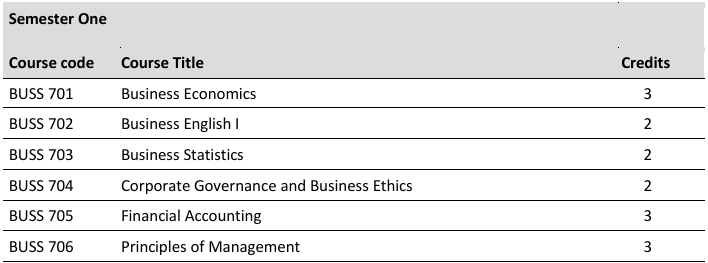
Semester one
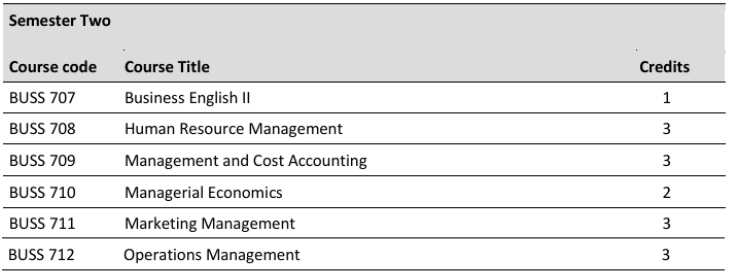
Semester Two
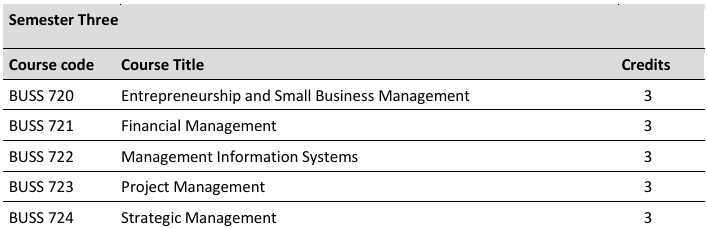
Semester Three
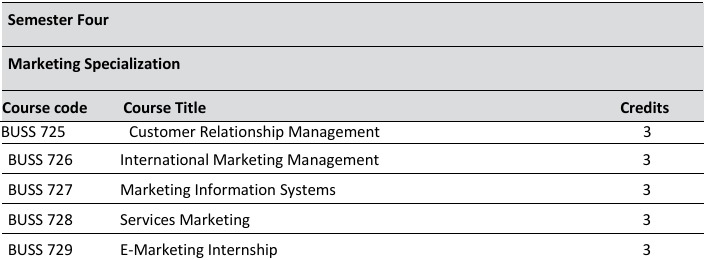
Semester Four - Marketing Specialization
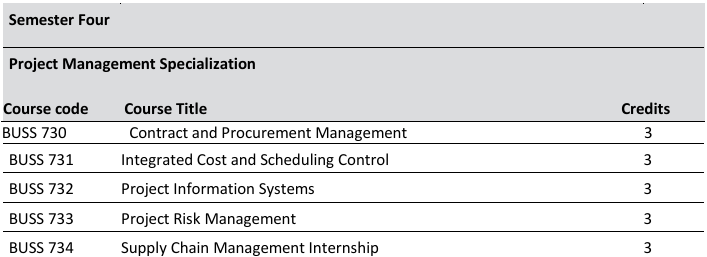
Semester Four - Project Management Specialization
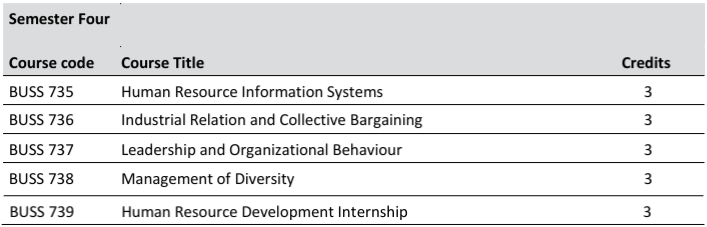
Semester Four - Human Resource Specialization
Course Descriptions
BUSS 701 Business Economics 3 cr.
The course covers economic theories that represent a basis for understanding the economic environment which influences business and managerial decisions. It is divided into two parts; Microeconomics which deals with small units in the economy, and Macroeconomics which deals with issues related to the overall economy.
BUSS 702 Business English I 2 cr.
The course enables the students to deal with reading materials of a scientific nature. It emphasizes the skills of describing processes in the context of Business Administration and management. The focus is on helping students to better utilize varied forms of communications for the purpose of disseminating information and describing business processes.
BUSS 703 Business Statistics 2 cr.
This course provides the students with the knowledge and skills of basic statistics and its uses in business. It assists students to apply statistical models in forecasting and decision-making in business.
BUSS 704 Corporate Governance and Business Ethics 2 cr.
This course covers the theories of ethics and corporate governance and its importance in organizational management. The legal and ethical parameters and the international standards for auditing the social and ethical performance of organizations will be analyzed and examined. Issues such as corruption, human rights, sustainable development, recent events and experiences pertinent to corporate governance will be debated.
BUSS 705 Financial Accounting 3 cr.
This course introduces the basic principles, concepts and uses of accounting. It provides the students with the knowledge and practical applications and uses of financial reports, and shows their importance for reaching effective decisions by all business stakeholders.
BUSS 706 Principles of Management 3 cr.
This course is designed to give an overview of the major functions of management. Emphasis is placed on planning, organizing, controlling, directing, and communicating. Upon completion, the students should be able to work as contributing members of a team utilizing these functions of management.
BUSS 707 Business English II 1 cr.
This course is designed to develop the students’ language skills and communication skills within a business context. It develops a wide range of Business English skills covering areas as diverse as formal Report-Writing, presentation skills, sales and negotiation skills. It covers a wide range of functional areas including General Business and specializations such as English for Marketing, Trade and Investment and Finance.
BUSS 708 Human Resource Management 3 cr.
This course introduces the concept of HRM, its origin and the underlying factors, which gave rise to HRM. It also demonstrates HRM policies and practices in different contexts and discusses the new forms of work organization and employee involvement schemes as an alternative to the traditional personnel management. It explores how HRM deals with the rapid changing technological, socio-economic, political and legal environments.
BUSS 709 Management and Cost Accounting 3 cr.
The course aims to provide students with the knowledge of the concepts of management accounting as a system for recording, processing, reporting and analyzing of information for costing and managerial decision-making. The integration of work-based learning through practical applications allows students to identify and solve business problems or address real issues faced in organizations.
BUSS 710 Managerial Economics 2 cr.
This course provides basic knowledge in Managerial Economics and its theories and concepts. It explains how scientific decision making tools and techniques are used to help in reaching optimal solutions to managerial decisions related to the realm of economics and economic based problems within organizations and businesses.
BUSS 711 Marketing Management 3 cr.
This course introduces the concept of both the consumer and business marketplaces. The strategies necessary to market goods and services in a domestic and global environment will be discussed through an analysis of external and internal factors that impact the organization, and through the development of an understanding of the strategy components collectively referred to as the marketing mix.
BUSS 712 Operations Management 3 cr.
This course is a functional review of how to manage the activities involved in the process of converting or transforming resources into products or services. Topics include an overview of strategic decisions, forecasting, basic inventory models, aggregate planning and master scheduling, materials requirements planning, and scheduling of operations.
BUSS 720 Entrepreneurship and Small Business Management 3 cr.
This course introduces entrepreneurship evolution, definitions and approaches stressing on innovation and creativity as basic notions of entrepreneurship. It examines generic entrepreneurial and small business concepts, theories and features of small businesses management at the indigenous, local and global contexts. It examines the contribution of Sudanese SMEs and entrepreneurship to economic development, and identifies the challenges facing the survival and success of SMEs.
BUSS 721 Financial Management 3 cr.
This course explores the fundamental nature of the corporate finance function and the conceptual and theoretical underpinnings of tools for successful financial management. It provides the basic tools and concepts necessary for the handling of financial decisions. An array of cases is used in order to foster students’ ability to apply the tools and analytical skills to real-world situations.
BUSS 722 Management Information Systems 3 cr.
This course teaches how to analyze and define information systems requirements in various business situations and learn how to evaluate emerging disruptive technologies, how to align information technology with business strategy and how to address information systems needs from a business perspective. The course provides students with the knowledge and skills they need to effectively implement and use information systems to help reach the strategic objectives of their organizations.
BUSS 723 Project Management 3 cr.
This course provides the foundations of Project Management and how structured into Planning, Organization and Control. It considers the structured approach and concepts of Project Management, and provides practical components pertinent to the identification, planning and implementation of projects. Issues of resource allocation and control for timely fulfilment of project outcomes, project risks and challenges will be tackled.
BUSS 724 Strategic Management 3 cr.
The course intends to convey to the student an understanding of how and why strategic decisions are made and how and why they are important to the executive in terms of securing resources to the unit, improving the job performance and changing the career.
BUSS 725 Customer Relationship Management 3 cr.
This course focuses on process, strategy and technology by providing the fundamentals of Customer Relationship Management (CRM) through the implementation of CRM systems and analysis of data to build and maintain profitable customer relationships by delivering value and satisfaction to customers.
BUSS 726 International Marketing Management 3 cr.
This course focuses on the realities of international marketing as it affects the activities of different companies in a country. International forces impact all companies and individuals making marketing decisions. The decision to operate on a global scale requires a different set of marketing coordination activities.
BUSS 727 Marketing Information Systems 3 cr.
This course focuses on how new information technologies are changing the nature of marketing management. It addresses foundations of electronic customer relationship management, one to-one marketing and personalized communication. From an applied perspective, the course explores how state-of-the art Web technologies, point of sale data gathering and electronic market research can improve decision-making and provide a competitive advantage in global markets.
BUSS 728 Services Marketing 3 cr.
This course builds upon and expands the marketing management philosophy, concepts and models and adopts them to the service sector. It deals with how to manage service development and quality, increase and maintain customer satisfaction levels, generate customer loyalty and create a healthy service culture within the firm. It will discuss the 7Ps of the ‘’Service Marketing Mix’’, in addition to internal and external marketing relationship management.
BUSS 729 E-Marketing internship 3 cr.
This course helps the students to acquire the skills of the execution and reporting of online marketing campaigns across email and social media platforms.
BUSS 730 Contract and Procurement Management 3 cr.
This course explores the contract management process in three broad phases: pre contract, contract and post-contract. Each step of the phases will be addressed from both the Buyer and Seller perspectives, in both the general and commercial environments. Key learning points include procurement planning, bid and proposal preparation, source selection, and contract administration.
BUSS 731 Integrated Cost and Scheduling Control 3 cr.
This course, compliant with the Project Management Institute’s (PMI’s®) current Project Management Body of Knowledge (PMBOK® Guide, 5th Edition), focuses on the importance of developing an accurate, enforceable project schedule. It also gives project managers the tools they need to develop reliable cost estimates and to perform integrated cost and schedule control.
BUSS 732 Project Information Systems 3 cr.
This course introduces a basic knowledge of software project management principles including software requirements specifications, software life-cycle models, software project scheduling, monitor and track deadlines and project risk management. The course provides the skills of project scheduling and assigning resources, choosing an appropriate project development methodology and identifying project implementation control and follow-up.
BUSS 733 Project Risk Management 3 cr.
This course addresses the project risk management processes of identification, analysis, response development and control. The course provides the theory and practice on all of the PMI Risk Management Processes with emphasis on developing the Risk Register. Risk Planning will be practiced as an integral part of the overall project planning sequence. Risk Identification involves hands-on practice, both qualitative and quantitative analysis techniques. Response plans for influential risks will be developed and analyzed.
BUSS 734 Supply Chain Management Internship 3 cr.
This course covers the role and operations of supply chain in business organizations. The course provides the students with the skills to design and develop effective supply chain systems to achieve competitive advantage and to boost efficiency and effectiveness of supply chain by utilizing appropriate technology.
BUSS 735 Human Resource Information Systems 3 cr.
This course provides a basic overview of various automated information systems that are available to support today’s Human Resource Professional to utilize information systems and other automated processes pertinent to Human Resource Management. The course explores other methods to increase recruiting, simplify interviews and permit easier employee or prospect access to an organization’s human resource offices. The course also focuses on systems security and individual privacy as well as legal implications to users and organizations.
BUSS 736 Industrial Relations and Collective Bargaining 3 cr.
The course provides a basic understanding of the collective bargaining process within the framework of negotiations between an employer and union to determine the conditions of employment. The course will also explore the legislation affecting the collective bargaining process.
BUSS 737 Leadership and Organizational Behavior 3 cr.
This course introduces human behavior combined in theory and practice to show how individuals, teams, and organizations function within the context of human relations in enterprises. Particular emphasis is placed on the role of leaders in organizations. It casts light on leadership concepts, development and attempts to explain how managers can become effective leaders.
BUSS 738 Management of Diversity 3 cr.
The course introduces the concept of diversity and its management locally and globally in work places and markets. It acquaints students with the dimensions of diversity, the multicultural organization, the significance of diversity as a business case, the role of diversity in creating opportunities for improved performance and greater creativity in enterprises and in expanded markets. It examines the strategies of inclusion and the attitudes towards diversity in the workplace.
BUSS 739 Human Resource Development internship 3 cr.
This course provides knowledge and skills needed for productive and satisfying work in which in turn is critical to organizational success. The focus of this subject is on job-learning within the context of the individual-organization relationship.
Master in Microfinance and Development
Mission
The mission of the MMFD program is to provide students with advanced, timely and appropriate knowledge in microfinance through a well-structured curriculum that fosters effective learning. The program emphasizes the use of teaching methodologies, analytical tools and techniques that are essential for enhancing the capacity of graduates in both the theoretical and the practical dimensions, necessary for the microfinance industry in the country.
Vision
The vision of the MMFD program is to produce qualified and knowledgeable female professionals in the field of microfinance capable of satisfying the needs of the microfinance industry, microfinance institutions (MFIs), and development agencies, at the national level, with excellence in performance according to international standards.
Admission
July of each year.
Admission Requirements
- This follows the Admission requirements set by the School of Graduate Studies and approved by the University Academic Council.
- Specific requirement is the applicant should hold an honour Bachelor Degree from AUW or an equivalent degree from another recognized institution in Management Studies.
Degree Requirements / Curriculum Outline
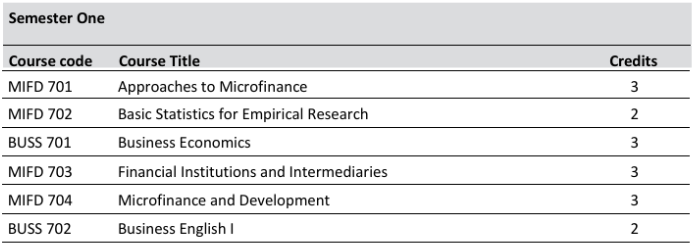
Semester one
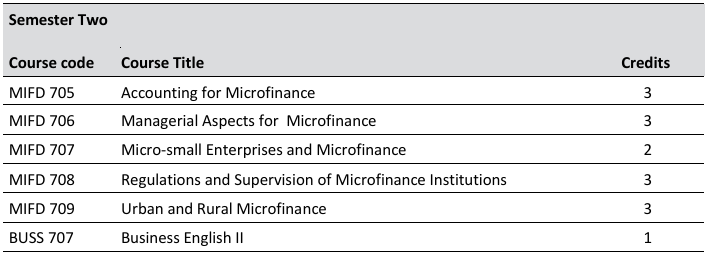
Semester Two
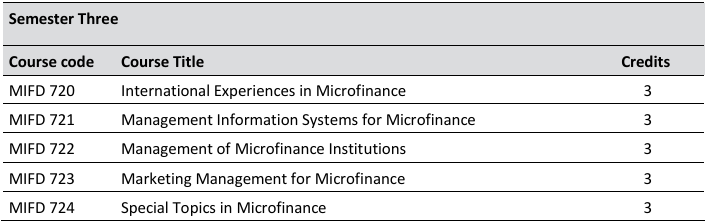
Semester Three
Course Descriptions
MIFD 701 Approaches to Microfinance 3 cr.
This course introduces microfinance approaches, principles and practices and examines key contemporary issues and debates. The course covers the various models of microfinance and the development aspects of microfinance activity including diverse approaches used in the for-profit and
not-for-profit sectors beside other topics.
MIFD 702 Basic Statistics for Empirical Research 2 cr.
The course provides the students with the knowledge and skills of basic statistics and its uses in business. It assists students to apply statistical models in forecasting and decision-making. The course is meant to orient the students with the fundamentals of empirical research and the application of statistical measures in scientific research.
BUSS 701 Business Economics 3 cr.
The course covers economic theories that represent a basis for understanding the economic environment which influences business and managerial decisions. It is divided into two parts; Microeconomics which deals with small units in the economy, and Macroeconomics which deals with issues related to the overall economy.
MIFD 703 Financial Institutions and Intermediaries 3 cr.
The course presents both theoretical and practical aspects of decision making in microfinance institutions. The primary focus is on commercial bank management with other components the business economics and the finance instruments and participants of the intermediaries.
MIFD 704 Microfinance and Development 3 cr.
This course provides the principles of microfinance and its role in sustainable approaches to international development covering the main business models of microfinance, leading microfinance institutions (MFIs) around the globe, typical products and services, and how microfinance has evolved over 25 years. It examines both NGO and for-profit organizational structures, and how they balance development and financial sustainability.
BUSS 702 Business English I 2 cr.
The course enables the students to deal with reading materials of a scientific nature. It emphasizes the skills of describing processes in the context of Business Administration and management. The focus is on helping students to better utilize varied forms of communications for the purpose of disseminating information and describing business processes.
MIFD 705 Accounting for Microfinance 3 cr.
The course covers financial accounting and managerial accounting, which is defined and contrasted with financial Accounting. The course also covers the process of managerial accounting and its use by managers in an organization, the major cost accounting systems and how they work in modern technological environment, planning and control systems through budgeting, standard costing and responsibility accounting principles.
MIFD 706 Managerial Aspects for Microfinance 2 cr.
The course aims at providing students with an introduction to different meaning and understanding of management so they can develop a critical understanding of the social and political implications of management practice on the success of microfinance related enterprise.
MIFD 707 Micro-small Enterprises and Microfinance 3 cr.
This course introduces the fundamentals, the concept and the different practice approaches of entrepreneurship. It focuses on the concepts of creativity and innovation and their relationship to entrepreneurs. The course examines generic entrepreneurial and micro-small (MSEs) business concepts and theories and the role of Sudanese MSEs and entrepreneurship in socioeconomic development besides the challenges and constraints facing its management and maintenance.
MIFD 708 Regulations and Supervision of Microfinance Institutions 3 cr.
The course examines contemporary legal and policy issues facing micro-finance supervision and regulation. It sets out an interdisciplinary exposition of the law. It provides an interface of financial services law and practice. Relevant aspects of business management and economic theory are examined as well. In addition it covers the supervision models of Microfinance institutions, and how the central regulatory and supervision frame is impacting on the MFIs.
MIFD 709 Urban and Rural Microfinance 3 cr.
This course is intended to enable students understand the theory of rural economic organization, and relates it to urban situations. It deals with rural versus urban financial market, rural and urban microfinance product innovation, concepts of value chain finance and appraisal of rural and urban microfinance programs.
BUSS 707 Business English II 1 cr.
This course is designed to develop the students’ language skills and communication skills within a business context. It develops a wide range of Business English skills covering areas as diverse as formal Report-Writing, presentation skills, sales and negotiation skills. It covers a wide range of functional areas including General Business and specializations such as English for Marketing, Trade and Investment and Finance.
MIFD 720 International Experiences in Microfinance 3 cr.
This course presents both theoretical and practical aspects of microfinance experience around the globe. The primary focus will be on best experience in Bangladesh, India, Switzerland, Nederland, Nigeria, Egypt, Jordan, and Sudan. A comparative approach will be adopted to familiarize these experiences to the Sudanese context, and to facilitate learning from best practices.
MIFD 721 Management Information Systems for Microfinance 3 cr.
This course introduces Management Information Systems (MIS) for the micro finance and the role of information systems in supporting a wide range of organizational functions. It examines the use of information systems in supporting administrative operations, decision-making, overall strategic initiatives, corporate philosophies and the use of information and communication technologies (ICT) by individuals and organizations within the microfinance industry to be more inclusive.
MIFD 722 Management of Microfinance Institutions 3 cr.
This course provides an in-depth understanding of microfinance institutions (MFIs) and their role in providing financial services to hundreds of the poor people. The course examines the commercial, operational and developmental aspects of microfinance, including in-depth reviews of some of the largest, most successful MFIs in the world and also learn about innovative management styles that
other types of financial institutions, including traditional commercial banks.
MIFD 723 Marketing Management for Microfinance 3 cr.
This course explores the basic principles of the marketing function its concepts for successful marketing
management that includes developing marketing strategies and plans. It focuses on the marketing management functions such as marketing research and the marketing mix, to be applied by the microfinance institutions and the micro- small scale enterprises (MSEs) to facilitate sustainable enterprise growth and sustain the microfinance industry.
MIFD 724 Special Topics in Microfinance 3 cr.
This course integrates more contemporary issues around microfinance (MF) as theory and practice. It is intended to enhance the students’ capacity in independent learning, writing –up and presentations of certain topics relevant to the MF practice.
Doctor of Philosophy in Business Administration
Introduction
The program PhD in Business Administration was launched in 2006 solely based on research. The program focuses intensively on preparing candidates for academic careers and to conduct highly specialized scholarly research, both in theory and application. They focus on the development of new theory in management, public administration, consulting, economics and several other related business fields.
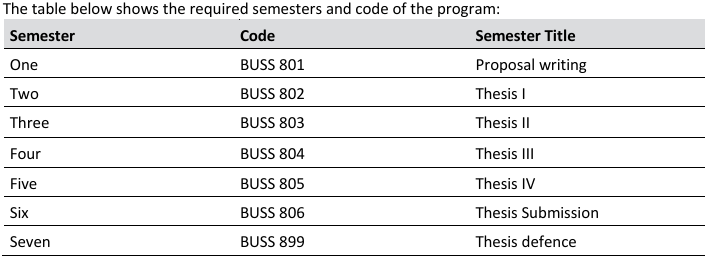
Degree Requirement