School of Languages
The School of Languages at Ahfad University for Women is dedicated to developing students’ linguistic and communication skills to support their academic and professional success. The School provides high-quality language instruction, promotes multilingual learning, and fosters effective communication in English, Arabic, and other languages. Through academic programs, preparatory courses, and professional training, the School contributes to enhancing students’ competencies and supporting the University’s educational mission.

The School plays a vital role in supporting students’ academic and professional development by strengthening their language and communication skills. We are committed to providing high-quality language education that meets international standards and responds to the diverse needs of our students and the wider community.
Through our academic programs, preparatory courses, and language services, we aim to promote multilingualism, critical thinking, and effective communication. We also strive to create a supportive learning environment that encourages innovation, collaboration, and respect for cultural diversity. We are proud to contribute to preparing graduates who are confident communicators and active participants in both local and global contexts.
Salah Alkarib - Dean of School of Languages
About
About the School
The School of Languages was established in 2015 (known as The English Language Unit since 1996, it was upgraded to an Institute in 2009) in order to coordinate the teaching of English in all schools of the University, to work towards improving the students’ standard in English and to run English language required courses, BA in English language / teaching and postgraduate degrees (Diploma, MA and PhD). The School also has four functions: teacher development, student development, material production, services and evaluation. The School is also responsible for administration of all courses of the University Preparatory Programme (English language courses, Study Skills, Talent Development and Arabic courses).
Vision
To be among the leading international schools to advance the professional practice of counselling and health psychology and early childhood education by focusing on disseminating the knowledge we create, promoting our discipline and training our students as partners in advancing strong critical thinkers and communicators to cultivate skills necessary enhancing diversity, multicultural perspectives for the betterment of society.
Mission
To provide service quality language instruction for all individuals in or outside Ahfad University for Women who need to use English as medium of communication, for academic or professional purposes, in addition to the instruction of other languages such as Arabic and French.
Core Values
The main core values are:
• Abiding by international academic standards of language teaching and learning.
• Continuity in keeping abreast of developments in the field.
• Academic integrity
• Encouraging enquiry and expression.
• Collaboration.
• Achieve professionalism in language education.
• Foster respect for diversity and multiculturalism.
Staff

Salah Alkarib
MA, University of London, 1966, Professor; Dean

Amna Mohamed Bedri
Ph.D., University of Khartoum, 2001, Associate Professor.
Amna Abdelgadir
Ph.D., University of Reading, 1993, Associate Professor.
Eiman Abbas
Ph.D. SAOS, 2004, Assistant Professor.
Abu El GasimAbd El Rahman Adam
M.A., University of Sudan for Science and Technology, 2014, Lecturer.
Amira Ahmed Mohammed Alnagar
M.A., ELT- University of Khartoum, 2011, Lecturer.
Amira AltijaniShoaib
M.A., English Literature, Neelane University, 2015. lecturer
BoranYusifBadri
MA, University of Edinburgh, 1988, Lecturer.
Mohamed El Sheikh AbdAlla El Shafeea
M.A, University of Khartoum, 2014, Lecturer.
Omar Yousif El Hassan
M.A,Nile Valley University, 2010, Lecturer.
Mujtaba Saeed Arman
M.A. – University of Juba, 2005, Lecturer.
Safa Abdelhameed Mohammed
MA, University of Khartoum – 2010, Lecturer.
Undergraduate Programs
Curriculum
The School is presently focusing on implementing four academic programs in the following specializations:
• Nutrition and Dietetics
• Public Health
• Physiotherapy
The enrolled students will get B.Sc. Honours in Health Sciences with different majors. The earmarking of the students will be after the freshman year.
Admission into any major depends on academic performance, available places and student preference.
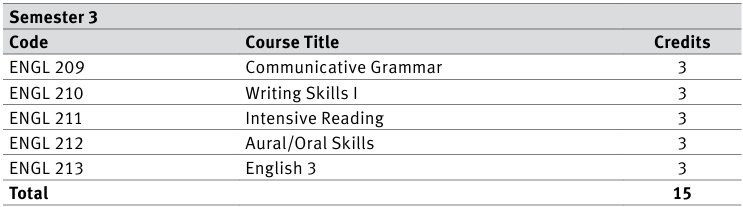
Semester 3
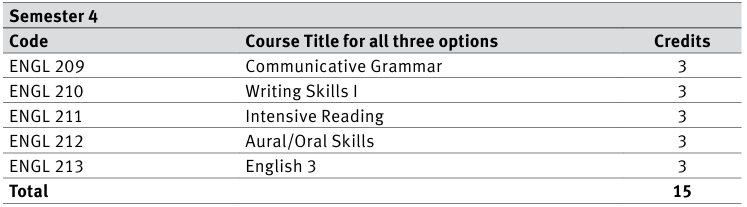
Semester 4
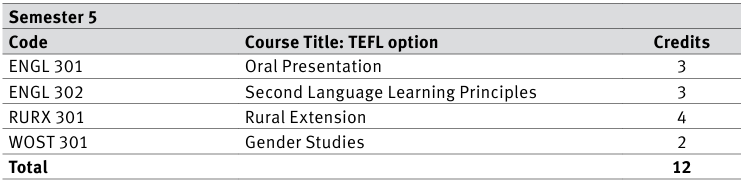
Semester 5
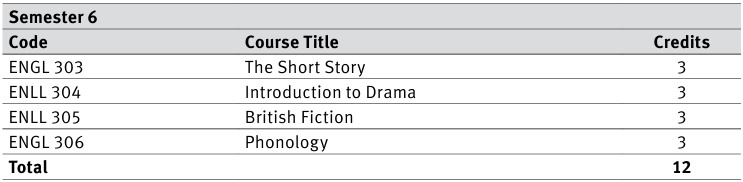
Semester 6
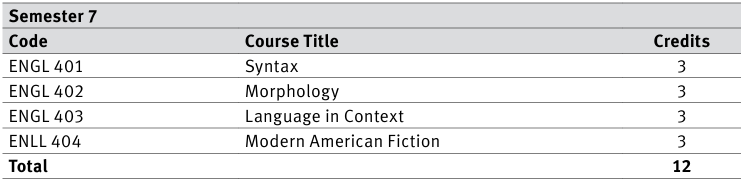
Semester 7
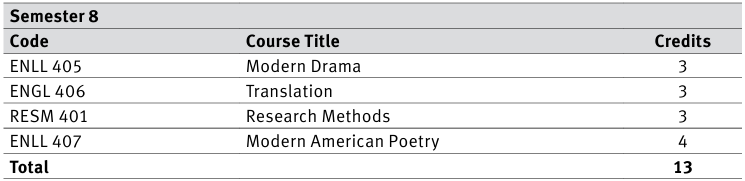
Semester 8
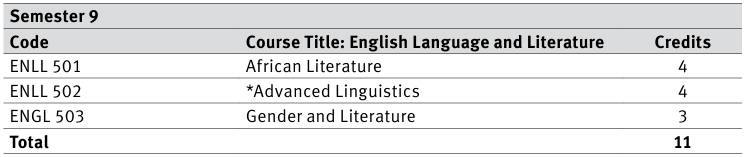
Semester 9
Semester 10
Semester 3
Semester 4
Semester 5
Semester 6
Semester 7
Semester 8
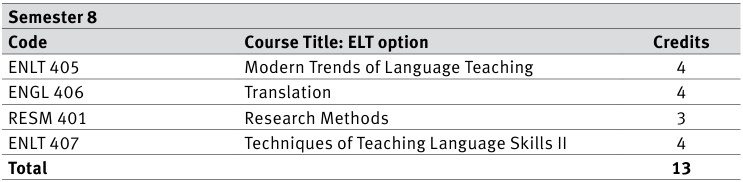
Semester 9
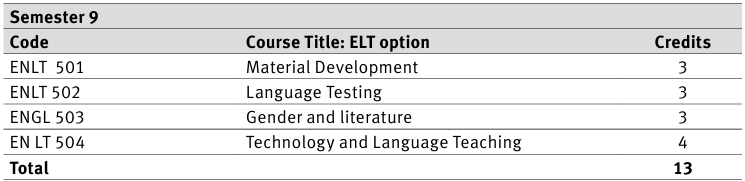
Semester 10
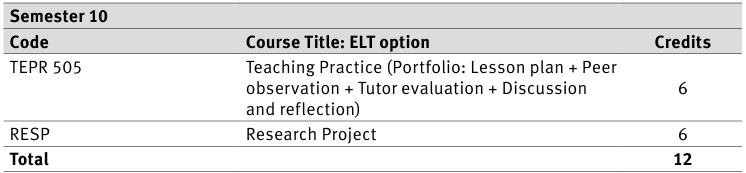
Course Descriptions
ENGL209 Communicative Grammar 3 cr.
This course focuses on structural forms, within communicative contexts. It will review and reinforce sentence boundaries, conjunctions, adverbs, questions, verb tenses and other grammatical needs of students. Individual as well as group assignments will be given, and the other skills of writing, speaking, and comprehension will provide contexts for the analysis and modification of English forms.
ENGL210 Writing Skills I 3 cr.
The course aims at helping raise the awareness of students to the structure of the English language and develop their writing. Students are exposed to authentic written texts of different genres and they are encouraged to produce similar texts besides relating their writing tasks to an audience and purpose and using different rhetorical functions.
ENGL211 Intensive Reading 3 cr.
This course aims at developing students’ reading skills, such as skimming and scanning, in addition to vocabulary and linguistics abilities, to help them achieve an adequate understanding of authentic written texts in different areas; and the ability to define their reading purposes and to read flexibly.
ENGL212 Aural /Oral Skills 3 cr.
This course covers the two components of Listening and Speaking. It prepares students to receive aural communication in both public and academic environments and to respond appropriately. Activities range from listening to and producing brief descriptions, directions, and dialogues, in addition to improving social and intercultural communication skills. Attendance is mandatory.
ENGL213 English III 3 cr.
This course builds on the previous courses of ENGL 101 and 102. The purpose of this course is two-fold: (1) to enhance learner confidence and fluency when using English for interactive and communicative purposes; (2) to improve upon study skills/strategies and critical and analytical thinking skills needed for successful academic work at the university level.
ENGL214 English Phonetics 3 cr.
This course lays emphasis on practical phonetics and pronunciation. A short component in practical phonetics will be given as an introduction. Particular emphasis will be placed on class participation, group work and pronunciation work. Some classes may be conducted outside of the classroom (e.g. in the computer lab).
ENGL215 Extensive Reading 3 cr.
The course contains a selection of reading materials and activities which aim at producing autonomous readers; such materials include selected reading articles of current issues from journals, magazines, internet, reading books and novels. It is accompanied by activities for developing students reading skills (note taking, presentation, conducting seminars, debate).
ENGL216 Writing Skills II 3 cr.
This course builds on the previous course with more emphasis on the discourse aspects of writing and more detailed analysis of written texts covering different genres. Each writing task is preceded by a discussion of the presupposed audience, purpose, relevance, style, coherence, organization and purpose based on a written model.
*The course of Writing Skills I is a prerequisite*
ENGL217 Introduction to Linguistics 3 cr.
This course aims to help students understand the phenomenon of language and familiarize them with the basic linguistic concepts such as the specific properties of human language, levels of language analysis and fundamental concepts related to language study and development of linguistics.
ENGL218 Introduction to Literature 3 cr.
This course introduces students to a more creative use of the language covering different literary genres. It develops students’ interest in reading in general and literary texts in particular so as to understand and appreciate underlying style of language, cultures and ideologies. This is will eventually help them to develop their stylistic abilities, creative writing and their appreciation for reading literature.
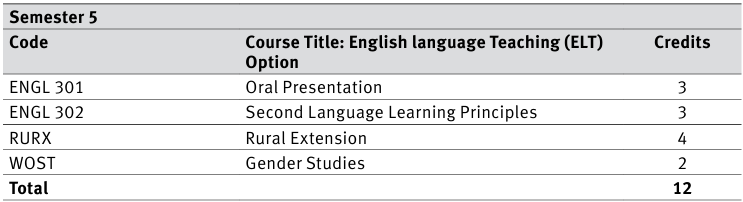
ENGL301 Oral Presentation skills 3 cr.
This course helps to equip the students with necessary skills to make effective presentations such as to plan, collect information from written material, interviews, surveys, etc., and deliver the presentation using audio/visual aids.
ENGL302 Second Language Learning Principles 3 cr.
By the end of this course, students will be introduced to the major issues and theories in the field of second language learning and first language acquisition. The course will also discuss the process and factors affecting language learning.
WOST301 Women Studies 2cr.
RURX401 Rural Extension 4cr.
SHORS303 The Short Story 3cr.
An introduction to the genre of the short story, including the elements of the form: narration, point of view, character, plot and metaphorical language. Students will sample a broad spectrum of short stories to explore the scope and variety of this form of literature. Point of view, characterization, language, and other elements will be emphasized; students will analyze, interpret, and evaluate the stories.
ENLL304 Introduction to Drama 3 cr.
An introduction to the nature of theatre as a performing art. Students study selected plays from the perspectives of characters, language, themes and context. Students will examine the strategies of playwrights to develop the ability to imagine the play in performance and to appreciate the range of theatre’s possibilities.
ENLL305 British Fiction 3cr.
This course provides a survey of modern British fiction and its writers. A close critical reading of three novels allows students to understand each work on its own terms, and what it represents relating it to the writer’s work on the one hand and the major themes of modern British fiction on the other.
ENGL306 Phonology 3cr.
This course covers a classification and description of English sound, the nature and structure of the English syllable, word stress, sentence stress, intonation and sound change in modern English besides the English phoneme.
ENGL401 Syntax 3cr.
This course will help students to have better understanding of the nature of the syntactic system of language. The course also aims at widening students’ knowledge about surface structure and deep structure, revising previous knowledge of grammar and exposing students to methods of syntactic analysis relating it to the meaning of sentences.
ENGL402 Morphology 3 cr.
This course introduces the study of English morphemes and word structure including the process of affixation. It will also involve analysis of sentences at the word level and different kinds of inflections.
LCON403 Language in Context 3cr.
This course provides an introduction to discourse analysis and the different approaches used in the analysis of written and spoken discourse. The course will also look into language variation and change besides the study of the relationship between language and society and analysis of language in social situations.
ENLL404 Modern American Fiction 3cr.
This course is a survey of American literature and literary history, from the early colonial period to the present. The aim of the course is to acquaint students with American literature in its different genres. Students are expected to read some representative novels, poems and plays.
ENLL405 Modern Drama 3cr.
This advanced course in modern drama offers an exciting mix of critical thinking, creative writing and performance practice via studying an array of selective works written for European and American theatre from the classical period to present. Students discuss and analyze plays; identify basic elements which distinguish modern drama from earlier periods; and develop their skills in speaking and debate.
*The course of DRAM 302 Introduction to Drama is a prerequisite*
RESM Research Methods 3cr.
ENGL406 Translation 4cr.
The course aims to introduce students to the skills and techniques which they need to translate well and with confidence. The course offers practical approaches to translation. It is based around topic areas, incorporating study of different text-types, style, use of dictionaries, text comparison, collocation, equivalents, and practical hints and tips. The Course will also identify and discuss basic concepts and problems in the area of Translation Studies. Participation in translation work in class is mandatory.
ENLL407 Modern American Poetry 3cr.
This course is intended to introduce students to the different elements of poetry exemplified in a variety of American poems and to study selected poems representing different periods in the development of American poetry.
ENLL501 African Literature 4cr.
This course will cover different genres of African literature; the body of traditional oral and written literatures in Afro-Asiatic and African languages together with works written by Africans in European languages or translated into these languages.
ENLL502 Advanced Linguistics 4cr.
This course introduces students to schools of linguistics and important linguists and their contribution in the field of language theory, study, teaching and learning. Prerequisite: LING 202.
ENGL503 Gender and Literature 3cr.
This course will explore the relationships between language and gender from a variety of perspectives, in addition to gender related literary theories. Among the topics to be covered are sex differentiation in language, gender profile in different writing, gender and language change, and gender and power issues. The course also aims to increase awareness of gender-related issues and literary theories.
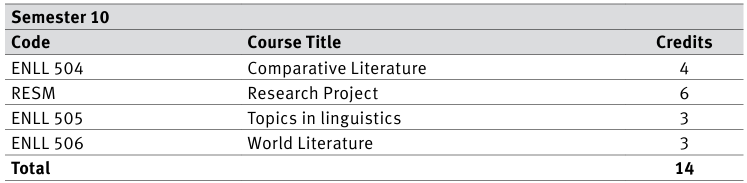
ENLL504 Comparative Literature 4cr.
This course encourages students to make comparisons – and connections – between themes and motifs in different literatures and cultures. As well as having the opportunity to study a range of genres, time periods, and national literatures (all of which can be studied in translation).
ENLL505 Topics in linguistics 2cr.
In this course students choose a topic of their interest in the field of linguistics and write an extended essay on it. Then they present their topics to the class in a well thought out and prepared presentation.
ENLL506 World literature 3cr.
This course deals with literature that has a readership and an impact beyond its original language and cultural area. Students will be introduced to masterpieces of world literature in the original languages and in translation.
BA English – English Language Teaching Option
ORPR301 Oral Presentation skills 3cr.
This course helps to equip the students with necessary skills to make effective presentations such as to plan, collect information from written material, interviews, surveys, etc. and deliver the presentation using audio/visual aids.
SLLP302 Second Language Learning Principles 3cr.
By the end of this course students will be introduced to the major issues and theories in the field of language learning and language acquisition.
WOST301 Women Studies 2cr.
RUEX401 Rural Extension 4cr.
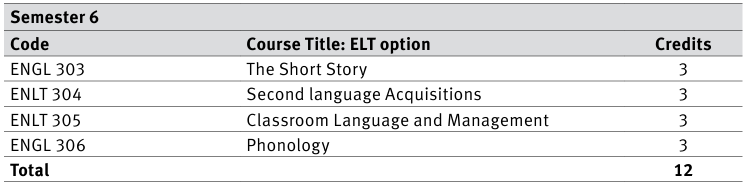
SHORS303 The Short Story 3cr.
An introduction to the genre of the short story, including the elements of the form: narration, point of view, character, plot and metaphorical language. Students will sample a broad spectrum of short stories to explore the scope and variety of this form of literature. Point of view, characterization, language, and other elements will be emphasized; students will analyze, interpret, and evaluate the stories.
ENLT304 Second Language Acquisition 3cr.
By the end of this course students will be introduced to the major issues and theories in the field of psycholinguistics. It covers areas such as speech perception, word cognition, semantic and syntax acquisition and theories of language acquisition. The course will also introduce students to the role of the brain and memory in the process of language learning and use.
ENLT305 Classroom Language and Management 3cr.
This course discusses techniques of classroom management in point of view of discipline, classroom interaction, responding to pupils’ mistakes and organizing the class for different language activities such as pair and group work.
ENGL306 Phonology 3cr.
This course covers a classification and description of English sound, the nature and structure of the English syllable, word stress, sentence stress, intonation and sound change in modern English besides the English phoneme.
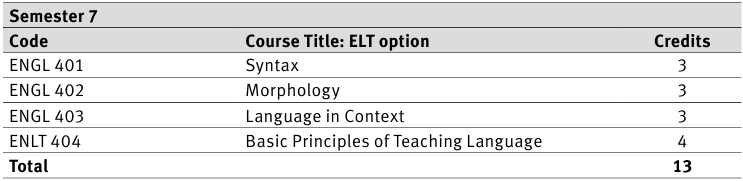
ENGL401 Syntax 3cr.
This course will help students to have better understanding of the nature of the syntactic system of language. This is done through lectures that trace the development of syntax. Students will do exercises and structural analysis to demonstrate their understanding of theory. The course also aims at widening students’ knowledge about surface structure and deep structure, revising previous knowledge of grammar and exposing students to methods of syntactic analysis relating it to meaning of sentences.
ENGL402 Morphology 3cr.
This course introduces the study of English morphemes and word structure including the process of affixation. It will also involve analysis of sentences at the word level and different kinds of inflections.
ENGL403 Language in Context 3cr.
This course provides an introduction to discourse analysis and the different approaches used in the analysis of written and spoken discourse. The course will also look into language variation and change besides the study of the relationship between language and society and analysis of language in social situations.
ENLT404 Basic Principles of Language Teaching 4cr.
This course intends to familiarize students as future English language teachers with the psychological, social, cognitive and educational theories underlying the process of teaching and learning language in general and English language in particular. The course will also include examination of teaching approaches and methods, a combination of lectures, discussion, and assignments will be used.
ENLT405 Modern Trends of Language Teaching 4cr.
This course is aimed at providing opportunity for teachers’ professional development in the field of ELT by introducing them to new trends in language teaching specially in the fields of teaching young learners of English and teaching literature. Through a number of readings and practical tasks they will gain a deep insight into how general teaching principles can be applied in the Young Learners EFL/ ESOL classroom. Students will also visit Basic schools and the Ahfad Centre for Early Childhood Education and will be required to design material and demonstrate its use in the classroom.
ENGL406 Translation 3cr.
The course aims to introduce students to the theories, skills and techniques which they need to translate well. By the end of the course they should have a basic level of competence which will enable them to translate a variety of simple text with confidence. Since the course is practical in nature attendance is mandatory.
RESM401 Research Methods 3cr.
ENLT404 Techniques of Language Teaching 2 4cr.
This course will introduce students to different teaching techniques and their evolution, in addition to advice and practical solutions on handling large classes and implementing task based and learner-centered teaching. The course also has a practical component where they will practice teaching techniques for teaching writing, reading, and grammar at different levels, during micro teaching sessions. This will help them relate theory to practice and to reflect on your own teaching practice to objectively assess their work and that of their peers.
ENLT501 Material Development 3cr.
This course surveys major methodological trends in curriculum and syllabus design, and provides an overview of ESL materials and an analysis of ESL texts. While engaged in extensive review of existing materials, students explore possibilities for adaptation, supplementation and the development of original materials for specific ESL populations.
ENLT502 Language Testing 3cr.
This course will help students appreciate and understand that the relation between testing and teaching is central and may have effects on the educational policy. The student will be equipped with the necessary skills for all stages of the assessment process and to design effective tests, their types and purposes.
ENGL503 Gender and Literature 3cr.
This course will explore the relationships between language and gender from a variety of Among the topics to be covered are sex differentiation in language, gender profile in different writing, gender and language change, and gender and power issues. The course also aims to increase awareness of gender-related issues and literary theory.
ENLT504 Technology and Language Teaching 4cr.
This course provides students with a theoretical framework on using technology in language learning/ teaching. It traces the developments of. It also stresses the types and patterns of technology employed by each school for Language learning/ teaching, such as the use of CALL, PCs, e-mails, Internet, and multimedia, in promoting language skills and components. For this reason, it requires students to have basic word processing, internet and emailing skills. The course will also help students to develop materials for language teaching in order to assist the learners to acquire and retain knowledge, and vocabulary.
ENLT505 Teaching Practice 6cr.
This course is designed to give students supervised practical application of previously studied theory: advanced practicum in teaching English language. This will help them relate theory to practice and to reflect on their own teaching practice and objectively assess their work and that of their peers. Students are also expected to be able to demonstrate techniques of controlling the class in the area of time and management and establishing a positive teacher-learner relationship.
Students are evaluated according to a Portfolio: Lesson plan + Peer observation+ Tutor evaluation + Discussion and reflection).
RESP Research Project 6cr.
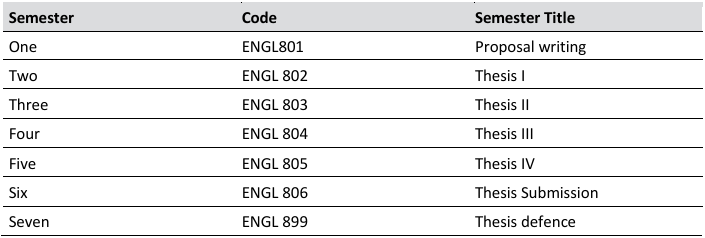
Graduation Requirements
Graduation Requirements
The requirements for a BA (Honors) degree in Language or Literature are 94 credits for students entering the BA Program at the sophomore level. The distribution requirements for these course credits are explained in the following sections.
Postgraduate Programs
Diploma in English Proficiency and Communication
Mission
To provide quality English language instruction to all graduates who aspire to improve their standard of English language proficiency and communication skills for academic or professional pursuits.
Vision
To graduate English language learners who can communicate effectively in English for academic or professional purposes.
Admission
July of each year.
Admission Requirements
• This follows the Admission requirements set by the School of Graduate Studies and approved by the University Academic Council.
• Graduates from any discipline could apply.
Degree Requirements

Degree Requirements / Curriculum Outline
Semester one
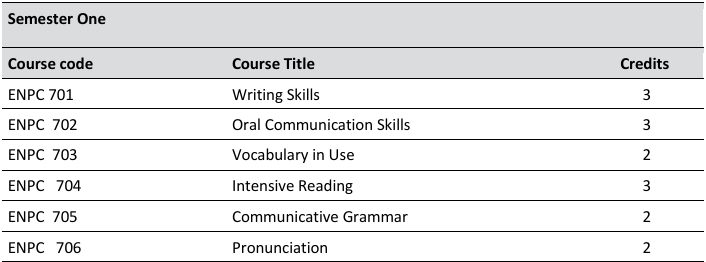
Semester Two
Course Descriptions
ENPC701 Writing Skills 3cr.
This course helps students to develop their writing skill and encourage them to relate their writing tasks to an audience and purpose. Emphasis is on the production of written work preceded by a brainstorming session. Tutors focus on the writing process rather than the end product. Each writing task is preceded by a discussion of the format, style, coherence, organization of different parts based on a written model.
ENPC702 Oral Communication Skills 3cr.
This course helps the students to improve their oral communication skills of English. Classes provide maximum opportunity for participants to use the language for interaction. To refresh the speaking and listening skills students have to talk, listen and practice the language with more confidence.
ENPC703 Vocabulary in Use 2cr.
This course helps students to acquire new vocabulary and use them in different contexts. It will also help them to use guessing and prediction skills to find meaning of words besides using the dictionary. The course will also familiarize students with word formation and semantic relations between words.
ENPC704 Intensive Reading 3cr.
This course develops students reading skills, vocabulary and linguistics abilities, to help them achieve an adequate understanding of authentic written texts in different areas, the ability to define their reading purposes and to read flexibly. It also introduces students to variety of language use and registers, beside more exposure to the language culture. Scanning and skimming.
ENPC705 Communicative Grammar 2cr.
This course widens students’ knowledge about surface structure, to revise knowledge of grammar and expose to methods of syntactic analysis relating it to meaning the major characteristics of English; selection and application of appropriate terminology to describe and analyses the structure and systems of English. Students are expected to participate in classroom activities involving grammatical analyses of different structures.
ENPC706 Pronunciation 2cr.
This course is intended to improve the student’s pronunciation through modelling and intensive practice. The course will also cover a classification and description of English sound, the nature and structure of the English syllable, word stress, sentence stress and intonation.
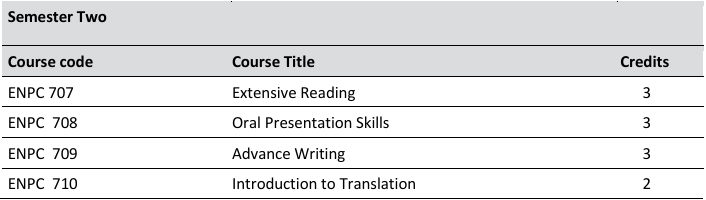
ENPC707 Extensive Reading 3cr.
The course aims at improving students’ reading skills, vocabulary building and comprehension in their future professional and academic life. The course comprises reading of short stories followed by activities for vocabulary building and comprehension and authentic outside class time readers followed by various tasks: presentation/ book review/ summary writing.
ENPC708 Oral Presentation Skills 3cr.
The course provides an advanced level in spoken English so that the students will feel comfortable talking fluently about and teaching a variety of topics. Participation in classroom interaction(individually and in groups), debates, role play and making presentations are part of the course
evaluation.
ENPC709 Advance Writing 3cr.
This course builds on the previous writing course with more emphasis on the discourse aspects of writing and more detailed analysis of written texts. Each writing task is preceded by a discussion of the presupposed audience, purpose, relevance, style, coherence, organization and purpose based on a written model. Emphasis is on the process of producing written work.
ENPC710 Introduction to Translation 2cr.
The course introduces the skills and techniques, which are needed to translate well. It is based around topic areas, incorporating study of different text-types, style, and use of dictionaries, text comparison, collocation, equivalents, and practical hints. It provides opportunities for practice and application and procedures for selecting appropriate texts, typical translation problems in language pair and the ability to identify them in both directions.
Master of Arts in English Language Teaching
Mission
To provide quality postgraduate studies in English language teaching introducing new trends and practical solutions that will lead to more efficient instruction and learning of the language. By exposing candidates to a variety of theories, classroom pedagogy and practical application, they will be able to contribute to research and creative activity in the field of English Language Teaching to serve the public good.
Vision
To graduate English language teachers who are competent and effective both in their classrooms and as members of the profession.
Admission
July of each year.
Admission Requirements
• This follows the Admission requirements set by the School of Graduate Studies and approved by the University Academic Council.
• Specific requirement is the applicant should hold an honor Bachelor Degree from AUW or an equivalent degree from another recognized institution in English Language / Literature / Linguistics or Education.
Degree Requirements

Degree Requirements / Curriculum Outline
Semester one
Semester Two
Semester Three
Semester Four

Course Descriptions
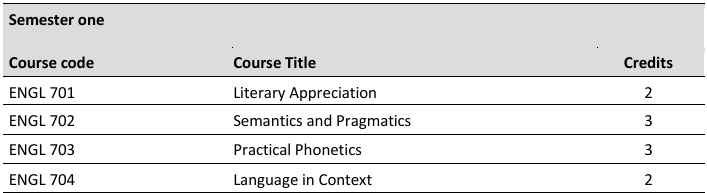
ENGL701 Literary Appreciation 2cr.
This course develops the students’ appreciation for reading in general and for reading literary texts in particular and to understand underlying cultures and ideologies. Students will think critically about the literary texts and write a simple literary study on them. They will be acquainted with the different genres of English literature and the characteristics of each one as well as the different theories of literary criticism.
ENGL702 Semantics and Pragmatics 3cr.
This course introduces the terms semantics and lexicology as well as basic issues and concepts in the linguistic study of word meaning. They will be exposed to the various approaches to the study of meaning besides methods of semantic analysis. The course covers the nature and analysis of lexical meaning and help students to understanding the lexical meaning of words.
ENGL703 Practical Phonetics 3cr.
This course lays emphasis on practical phonetics and pronunciation. Practice on regional dialects, accents and phonetics will be covered. Students will also discuss teaching pronunciation in order to relate this course to their teaching context.
ENGL704 Language in Context 2cr.
This course provides an introduction to discourse analysis and the different approaches used in the analysis of written and spoken discourse. The course will also look into language variation and change besides the study of the relationship between language and society and analysis of language in social situations. It will start with a general overview of the phenomena included in the study of discourse, pragmatics, genre and register.
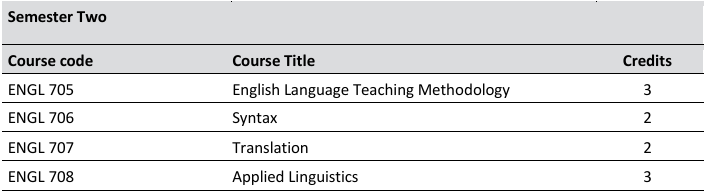
ENGL720 English Language Teaching Methodology 3cr.
This course provides the techniques of teaching the four skills and sub-skills of English language applying the appropriate procedure for each skill. It involves preparing lesson plans with teaching aids and trying it out during microteaching sessions. Students are expected to demonstrate techniques of classroom, time management and establishing a positive teacher learner relationship.
ENGL706 Syntax 2cr.
This course explains the nature of the syntactic system of language through the development of syntax, exercises and structural analysis to understand the theory. The course widens students’ knowledge about surface structure and deep structure, revising previous knowledge of grammar and exposing students to methods of syntactic analysis relating it to meaning of sentences.
ENGL707 Translation 2cr.
The course introduces students to the skills and techniques, which they need to translate well and with confidence. The course offers practical approaches to translation. It is based around topic areas, incorporating study of different text-types, style, use of dictionaries, text comparison, collocation, equivalents, and practical hints and tips. The course will also identify and discuss basic concepts and problems in the area of Translation Studies.
ENGL708 Applied Linguistics 3cr.
This course provides students with the psychological, social and educational theories underlying the process of teaching language in general and the English language in particular as a second language. Students will be familiar with the history and development of language teaching methods and approaches.
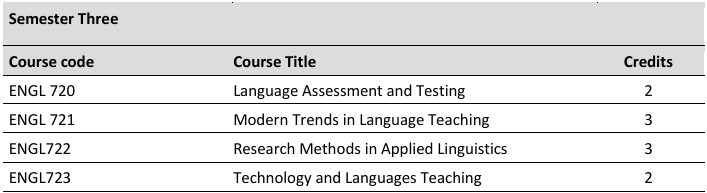
ENGL720 Language Assessment and Testing 2cr.
This course provides the relation between testing and teaching and its effects on the educational policy. The course covers all stages of the assessment process such as to able to identify the areas of weakness and find progress in their learners and to design effective tests, to identify types and purposes of tests and their validity and reliability through lectures, assignments, practical application. The course will also discuss error analysis and remedial work.
ENGL721 Modern Trends in Language Teaching 3cr.
This course provides new trends in language teaching especially in the fields of teaching young learners of EFL/ESOL and teaching literature. Through a number of readings and practical tasks students will gain a deep insight into how general teaching principles can be applied. Students will visit Basic schools and the Ahfad Centre for Early Childhood Education and will be required to design material and demonstrate its use in the classroom.
ENGL722 Research Methods in Applied Linguistics 3cr.
This course acquaints students with the different kinds and procedures of Qualitative and Quantitative research, purpose of research and the process of carrying out a research in the area of Applied Linguistics with special emphasis on action research. The course will end with writing and submitting a research proposal besides other assessments.
ENGL723 Technology and Language Teaching 2cr.
This course provides students with a theoretical framework on using technology in language learning/ teaching. It traces the developments of computer assisted language learning (CALL) and stresses the types and patterns of technology employed by each school for Language learning/ teaching. Students will practice in developing, designing, adapting and supplementing teaching material covering different language skills.
ENGL724 Teaching Practice 4cr.
This part of the Practicum is designed to give students supervised practical application of previously studied theory: advanced practicum in teaching English language and raise their awareness to possible problem areas of research. Students are given a two-week program for observation and a topic of focus for each session, which will be accompanied, by tasks and observation schedule. Students attend model lessons in Ahfad Basic and Secondary schools followed by discussion sessions in location then students hand in completed tasks. Students are required to teach 12 lessons or a sequence of lessons, besides compiling a Portfolio (10-12 items); lesson plans, observation of peers, report on pupils’ aptitude and problems, report of tutors on observation, reflection on their performance, marked by more than one tutor.
ENGL766 Thesis 6cr.
It is a practical component of the concepts introduced in the Research Methods course and is based on the research proposal submitted in semester three. Students are required to present the proposal of the research in a seminar, conduct the research and write the thesis.
Doctor of Philosophy in English Language
The PhD program in English Language was introduced in 2014. It is solely research-based touching all aspects of English as second language in reading, writing and listening activities for academic purposes, across the curriculum and in Teacher Education. Pedagogies: reading comprehension, grammar and oral communication pedagogy beside learner strategies, metacognition and motivation in second language acquisition are also addressed.
Degree Requirement