
School of Medicine
The School of Medicine at Ahfad University for Women is committed to preparing competent female physicians who contribute to improving health outcomes in Sudan and beyond. Through community-oriented education, innovative teaching methods, and strong academic foundations, the school equips students with the knowledge, skills, and values required for leadership in healthcare, research, and service. The program emphasizes women’s empowerment, social responsibility, and responsiveness to community health needs.

Our mission is to prepare highly qualified female physicians who are committed to excellence, compassion, and community service. Through a community-oriented curriculum and student-centered learning, we aim to develop graduates capable of addressing the evolving health needs of society.
We take pride in fostering a supportive academic environment that encourages innovation, leadership, and research. Our graduates are equipped not only with strong clinical knowledge but also with the values of integrity, social responsibility, and lifelong learning.
Prof. Inas Aziz -Dean of School of Medicine
About
About the School
Established in 1990, the School of Medicine adopts a Community-Oriented Medical Education approach supported by Problem-Based Learning (PBL) as a central educational strategy. This model focuses on addressing the health needs of individuals and communities while strengthening students’ analytical thinking, lifelong learning skills, and professional competence.
The curriculum integrates academic learning with early community exposure, allowing students to engage with diverse health conditions and understand the social determinants of health. Through partnerships with healthcare institutions and research bodies, the school promotes applied research and practical training that contribute to strengthening the healthcare system at both national and international levels.
The program is accredited by the Sudan Medical Council and is designed to graduate doctors who meet recognized international standards. Graduates are prepared to serve in both rural and urban settings and to contribute effectively to patient care, public health, and medical research.
Vision
To be a nationally prominent university and a leading institution recognized worldwide for its academic excellence, research, women empowerment, civic engagement and social responsibility. To be the leading medical school in the Sudan, nurturing a diverse community of medical people committed to leadership in alleviating human suffering caused by disease.
Mission
To provide quality education for women to strengthen their roles in national and rural development, and to seek equity for themselves and fellow women in all facets of Sudanese society using a combination of well-articulated academic programs, professional trainings, research, and community outreach activities. To pursue the improvement of the health of the Sudanese population through the delivery of high quality, community-oriented medical education and training and conducting innovative applied research.
Core Values
To achieve AUW’s mission and vision, we adhere to the core values of social responsibility, academic freedom, leadership, innovation, excellence, respect, integrity, ownership, commitment, diversity, inclusiveness, partnership, and autonomy at all domains of its work
(Education, Service and Research).
Staff

Inas Aziz
Dean of School of Medicine

Mohamed Osman Swar
MD, University of Khartoum, 1983, Professor, Dean
Kamal Elhag
MRC Pathology, Royal College of Pathology, 1977, Professor, Assistant Dean Academic Affairs.
Abdel Salam Eisa
FRCS, Royal College of Surgeons, UK, 1964, Professor.
Ali Al-Biely
DPH, University of London, 1979, Professor.
Asia Ahmed
PhD, University of London, 1981, Professor.
Badr Eldin Khalid
MD, University of Alexandria, 1987, Professor.
Lamyaa El-Hassan
PhD, Pathology, University of Jordan, 2003, Professor
Soad Babiker
Ph D, Alzaiem Alazhari University, 2008, Professor
Mohamed Baldo
MD, University of Khartoum, 1986, Professor.
Zuheir Sharfi
MSc; University of London, 1983, Professor
Amal Dardiry
MD, University of Khartoum1995, Associate Professor
Undergraduate Programs
Curriculum
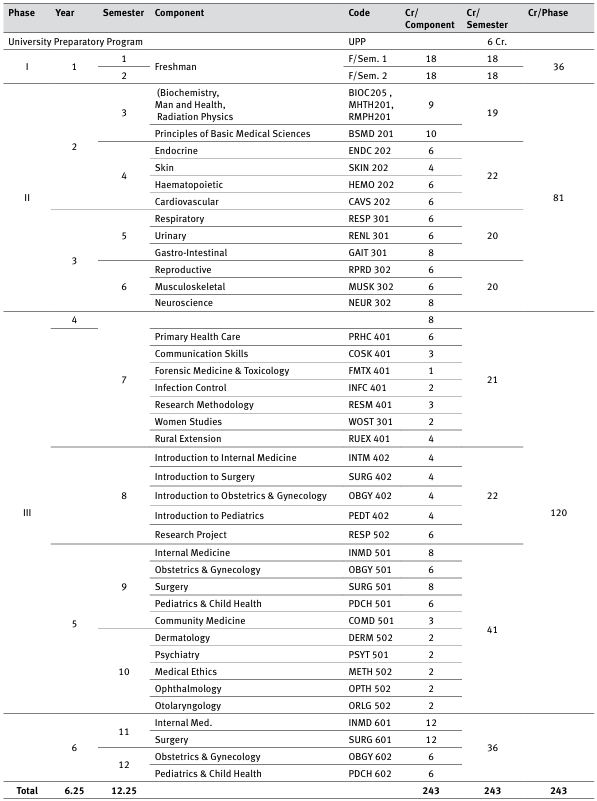
Study period in AUWSOM is 6 years spread over 12 semesters (in addition to the UPP) and assembled into three Phases.
Two semesters of 18 to 22 weeks are scheduled per year beginning in July and November/ December. AUWSOM’s curriculum is continuously revisited and reviewed in order to ensure the delivery of the most up-to-date and relevant content to students.
The curriculum is based on well-structured blocks and modules of integrated organ systems and themes organized in a spiral manner. The basic concepts shaping the curriculum appear throughout the program in the form of longitudinal courses that permeate the whole schedule.
These concepts are:
• Innovative teaching methods i.e. Problem Based Learning (PBL).
• Community Orientation, including early community and patient encounter, and health service provision e.g. Family Attachment Program (FAP),
• Integration: horizontal (between the various disciplines) and vertical (clinical and basic), and
• Clinical skills training at the different phases (Phase II at the Skills Laboratory and Phase III at various Health System Delivery levels).
Curriculum Map
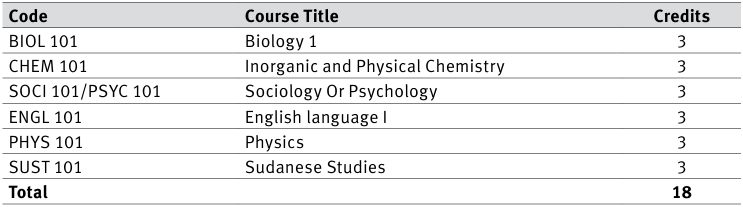
Phase I
Semester 1
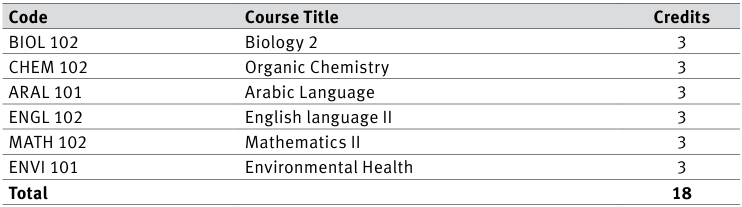
Semester 2
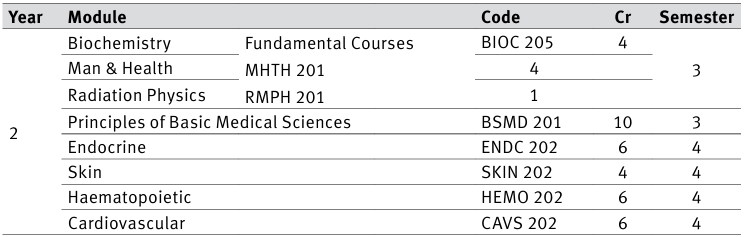
Phase II
Year 2
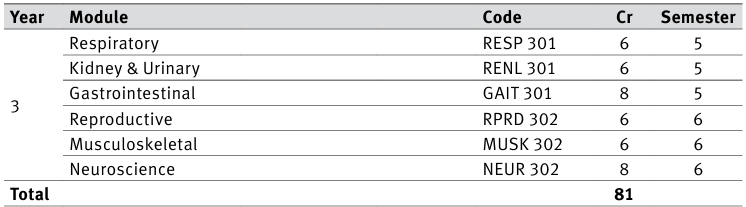
Year 3
Phase III
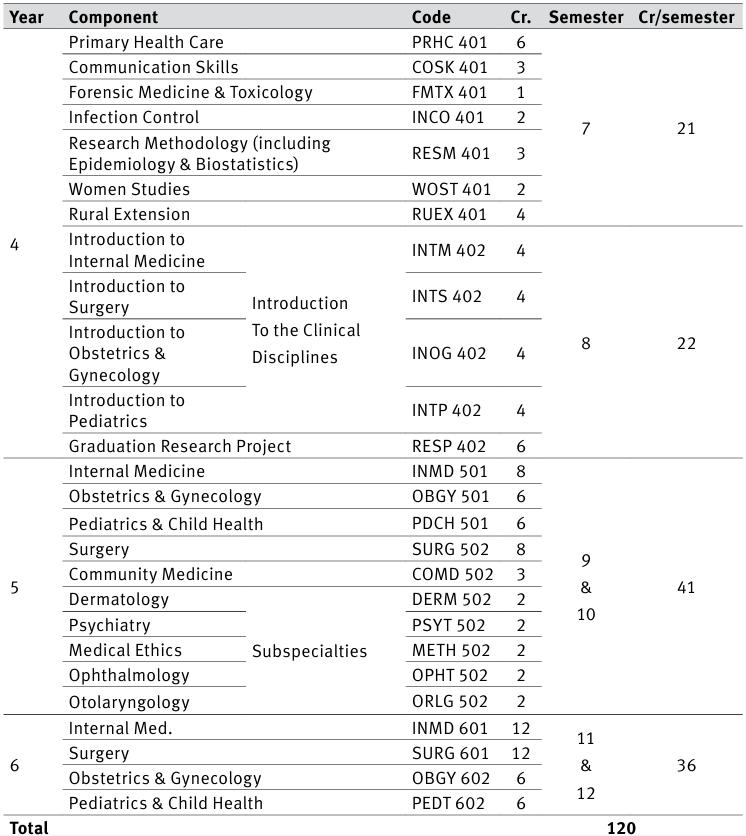
Year 4,5, & 6
Course Descriptions
Phase II
Phase II consists of 4 semesters. During this phase, normal and abnormal structure, function and behavior of the human body are learned in an integrated, Problem-Based Learning approach with special emphasis on clinical applications. These concepts are learned through 12 well
organized, Community-Oriented Modules mostly based on organ-systems. Duration of each Module varies from 6 to 10 weeks.
By the end of Phase II, the students will be able to explain the basic mechanisms, structure, function, pathophysiology, and psychosocial determinants of the major health problems, as well as plan for evidence-based management strategy of these problems- this includes using relevant investigations and advice to patients, their families and the community at large. Also, to demonstrate appropriate comprehension of the basic principles of medical professionalism, and to follow a teamwork and scientific approach throughout the various program learning activities.
During this Phase PBL is implemented as the main educational strategy using clinical problem scenarios that are relevant to our community. Problems work as a medium for integration (vertical and horizontal), a model that represents one of the major concepts shaping AUWSOM
curriculum.
Longitudinal courses in Phase II
• Skills Training Program (STP): This program is designed to lay the foundation for the clinical skills essential to the practice of medicine. The program is implemented at the Skills Laboratory (SL) where skills relevant to the Module’s theme are presented in small groups so that students have the opportunity to practice their skill under the direct observation of a faculty member. Clinical skills covered include physical examination, interviewing and communication skills. The SL is well-equipped with models and tools to facilitate skills training, in addition to models, students also learn through simulation.
• Family Attachment Program (FAP): it starts with some introductory sessions covering Communication Skills, and Counseling and Environmental Health. During this part of the program, Role-Plays are used to present and enable students freely to explore some of the
controversial/taboo topics. Students are then placed in the community; they are assigned to families which they follow for the course of the program; this aims to provide more authenticity to learning as well as service provision to the community, e.g. health education and referral for further management in Ahfad Family Health Centre with subsidized fees. This program is one of the Community-Based components of the Curriculum. Horizontal integration is between the various disciplines. Each Module is composed of the following disciplines:
• Human Anatomy: the scientific study of the morphology of the human body.
• Histology: the study of the microscopic anatomy of cells and human tissues.
• Embryology: a science which is about the development of an embryo from the fertilization of the ovum – the study of the early development of organisms.
• Biochemistry: the study of the chemical processes in living organisms; it deals with the structures and metabolism of biomolecules such as proteins, carbohydrates, lipids, nucleic acids.
• Physiology: the science of the mechanical, physical, and biochemical functions of humans in good health, their organs, and the cells of which they are composed.
• Radiology: the study of the interactions between ionizing radiation and living organisms and how this is used for diagnostic purposes.
• Pathology: the study of disease—the causes, course, progression and resolution of human body abnormalities.
• Microbiology: the study of microscopic organisms (microorganisms), including protozoa, bacteria, fungi, and viruses.
• Immunology: a broad branch of biomedical science that covers the study of all aspects of the immune system.
• Pharmacology: concerned with the study of drug action. More specifically, it is the study of the interactions that occur between a living organism and chemicals that affect normal or abnormal biochemical function.
• Community Medicine: a system of delivery of comprehensive health care (preventive, promotive, curative & rehabilitative) to the people by a health team in order to improve the health of the community. It deals with population or groups rather than individual patients.
• Epidemiology: the study of the demographics of disease processes, and includes, but is not limited to, the study of epidemics.
Assessment used during the Phase
Each Module is evaluated through formative and summative assessment methods. The End of Module Exam consists of written and practical components.
At the end of the Phase, students who successfully pass their examinations in all modules will be promoted to Phase III according to the school regulations.
Module Description
BIOC205 Biochemistry 4 cr.
During this course, the students will study the chemistry of carbohydrates, lipids, proteins, nucleic acids and Vitamins and Minerals. Teaching includes didactic sessions as well as practical work.
MHTH201 Man & Health 4 cr.
This course includes ancient history of Medicine, hazards of occupational health, and environmental health. Students will be introduced to the community through visiting some community settings e.g. schools, factories, NGO and the Water Management Directorate in the Locality.
RMPH201 Radiation Physics 1 cr.
This course deals with theoretical and applied radiation physics, interaction of charged particles, photons, generation of x-rays and energy transfer. It includes studying biomechanics, sound and hearing, pressure and motion of fluids, heat and temperature, electricity and magnetism in the body, biological effects of light, ionising and non-ionising electromagnetic radiations, static electric and magnetic fields, ultrasound and laser light.
BSMD201 Principles of Basic Medical Sciences 10 cr.
This is the first module in Phase II, during which students are introduced to the principles and general concepts in the basic medical sciences. PBL and its rationale are introduced to students as part of this module. PBL sessions are used as a platform for students to see the link between the various disciplines as well as appreciating their clinical application.
ENDC202 Endocrine 6 cr.
During this integrated Module students learn the anatomy, histology, biochemistry, physiology, pathology, immunology, and pharmacology related to the Endocrine system. Concepts in community medicine including prevention, and epidemiology are studied in relation to diseases of the endocrine glands and their hormones.
SKIN202 Skin 4 cr.
This Module integrates the histology, biochemistry, physiology, pathology, microbiology, immunology, and pharmacology of the skin, which is the outer surface of the body. Basic concepts are presented in which students are expected to learn the scientific basis of the normal physiology and pathology of the skin and its appendages including hair and nails. Concepts in community medicine including prevention, and epidemiology are studied in relation to diseases of the skin.
HEMO202 Haematopoietic 6 cr.
An integrated Module that covers the anatomy, histology, biochemistry, physiology, pathology, microbiology, immunology, and pharmacology related to the Reticulo- endothelium, haematopoietic organs and peripheral blood. Concepts in community medicine including prevention, and epidemiology are studied in relation to diseases of the blood.
CAVS202 Cardiovascular System 6 cr.
An integrated Module that covers the anatomy, histology, biochemistry, physiology, pathology, microbiology, immunology, radiology and pharmacology related to the cardiovascular system. Concepts in community medicine including prevention, and epidemiology are studied in relation to the Heart & Vascular System.
RESP301 Respiratory System 6 cr.
An integrated Module that covers the anatomy, histology, biochemistry, physiology, pathology, microbiology, immunology, radiology and pharmacology related to the respiratory system. Concepts in community medicine including prevention, and epidemiology are studied in relation to diseases of the Upper & Lower Respiratory Tracts.
RENL301 Kidney & Urinary System 6 cr.
An integrated Module that covers the anatomy, histology, biochemistry, physiology, pathology, microbiology, immunology, radiology and pharmacology related to the kidneys and urinary system. Concepts in community medicine including prevention, and epidemiology are studied in relation to diseases of the system.
GAIT301 Gastro-Intestinal System 8 cr.
This integrated Module covers the anatomy, histology, biochemistry, physiology, pathology, microbiology, immunology, radiology and pharmacology related to digestive tract and its accessory organs. Concepts in community medicine including prevention, and epidemiology
are studied in relation to diseases of this system.
RPRD302 Reproductive System 6 cr.
During this integrated Module students cover anatomy, histology, biochemistry, physiology, pathology, microbiology, immunology, radiology and pharmacology the reproductive systems (female & male). Concepts in community medicine including prevention, and epidemiology are
studied in relation to diseases of the reproductive systems including the basic knowledge of the reproductive process.
MUSK302 Musculoskeletal 6 cr.
This integrated Module covers the anatomy, histology, biochemistry, physiology, pathology, microbiology, immunology, radiology and pharmacology of the Musculoskeletal System including the bones of the skeleton and the cartilages, ligaments, and other connective tissue that stabilize or connect the bones. Concepts in community medicine including prevention, and epidemiology are studied in relation to diseases of this system.
NEUR302 Nervous System 8 cr.
This integrated Module deals with the most complex control system of the human body. The students will learn the anatomy, histology, biochemistry, physiology, pathology, microbiology, immunology, radiology and pharmacology related to the Central and Peripheral Nervous System, as well as concepts in community medicine including prevention, and epidemiology relevant to diseases of this system.
Phase III
Duration of Phase III is 6 semesters during which students rotate among the various health facilities in the primary, secondary and tertiary levels in a block system.
The phase starts by rotations and placements in the Primary Care settings. Training Health Centres (HC) are carefully selected in a way that ensures better exposure of Ahfad students to diseases found in the community, the availability of qualified health personnel that would support students’ training and supervision as well as the variability in population characteristics (e.g. ethnicity, social and financial standard). Residency in Rural Hospitals is intended to better expose students to the community and health services at rural settings and build up competency in teamwork practice.
The remaining bulk of the phase is devoted to the hospital-based training program (Clerkship). Students undertake clinical training in the major medical and surgical disciplines, with primary focus on core rotations in Medicine, Surgery, Obstetrics & Gynecology, and Pediatrics & Child Health as well as in clinical subspecialties such as Psychiatry, Dermatology, Orthopedics, Ear-Nose & Throat and Ophthalmology at different university allied hospitals and specialized centres. Their training program contains clinical work at patients’ wards, outpatient clinics and emergency departments, supplemented by didactic sessions to consolidate their knowledge base as well as integration of the basic sciences.
During this Phase, students also cover some of the university-required courses i.e. Women Studies, Rural Extension Program and the Graduation Research Project.
By the end of this Phase, students will learn the prevention and management of all relevant medical conditions, acquire a holistic approach to health, and develop clinical competence (knowledge, procedures/skills, clinical problem solving, and professional attitudes and behaviors). AUWSOM will ensure the graduation of qualified and competent medical doctors according to the standards of the SMC.
Assessment used during the Phase
This phase is evaluated through formative and summative assessment methods. Phase III Block Exams are conducted by the end of each block – these exams are part of the continuous assessment strategy of the Phase. Block Exams are also used to help the school and students note any deficiency in students’ learning and take timely corrective action through students’ academic advisors. At the end of the phase, the students sit for the final qualifying examination for the award of the Bachelor of Medicine and Surgery (MBBS).
PRHC401 Primary Health Care 6 cr.
Students will be placed in Primary and Secondary Health care facilities. This enables students to identify the services offered and problems encountered at these levels. During this course students are posted in various Primary Health Centres and Rural Hospitals; they are required to understand, observe and contribute in providing health services at these facilities.
FMTX401 Forensic Medicine & Toxicology 1 cr.
During this course students study the negative effects of chemicals, with special attention given to how they affect humans, the noxious effects of drugs and chemicals, and how these effects take place and how to avoid and treat toxicity. The course also introduces the basics of forensic medicine, and offers a chance for students to discuss relevant medicolegal cases so as to consolidate the learned concepts.
INCO401 Infection Control 2 cr.
By the end of this course, students will recognize the benefits to patients and health care workers of adhering to scientifically accepted principles and practices of infection prevention and control. They will acknowledge their professional responsibility to do so in all healthcare
settings and the consequences of failing to comply with these principles. Students will appreciate their responsibility to monitor infection prevention and control practices of those medical and ancillary personnel for whom she will be responsible and intervene as necessary to assure compliance and safety.
COSK401 Communication Skills 3 cr.
During this course students learn to improve their presentation skills, develop an appreciation of the interpersonal and situational dynamics of medical encounters, become oriented towards the communication tasks of a physician, and begin to build a base of skills and strategies associated with these tasks and apply a set of relevant skills and strategies.
RESM401 Research Methodology (including Epidemiology & Biostatistics) 3 cr.
The topics covered through this course comprise basic concepts in research methods in medicine and health sciences such as the research process, formulating study objectives, suggesting hypotheses, project planning, data collection and analysis, and presentation. The course also comprises core concepts in epidemiology.
WOST401 Women Studies 2 cr.
The course introduces Women and Gender Studies and the concepts and debates within these studies. It also tackles the assessment of the Sudanese women profile, in particular, and feminism and women’s movement, in general, as tools for promotion of women’s condition and positions to achieve empowerment and solidarity for action. (University Requirement).
RUEX401 Rural Extension
Check University Required Courses.
INTM 402 Introduction to the four major clinical disciplines each 4 cr.
INTS 402 INOG 402 & INTP 402 4 cr.
Through this course, students will have smooth transition from pre-clinical to clinical practice (Clerkship), they will be introduced to the various concepts, functions and procedures related to each of the four major clinical disciplines (Medicine, Surgery, Pediatrics and Obs & Gyn). The course is mainly hospital-based.
GRP402 Research Project 6 cr.
The students are required to conduct graduation research project and submit dissertations for partial fulfillment of the final degree. The research topic should involve a major health problem within the Sudanese community. (University Requirement).
INMD501&601 Internal Medicine 20 cr.
The goal of the Internal Medicine clerkship rotation is to assist the student with the development of competence in arriving at a formulation of the patient’s problem(s), which includes a provisional or established diagnosis, and possibly a differential diagnosis and to develop and implement a management plan for their problem(s). The rotation involves general medicine.
OBGY501&601 Obstetrics & Gynecology 12 cr.
The goal of this clerkship is to emphasize health care for women of reproductive and postmenopausal ages. Students will rotate through three clinical segments, including outpatient services (emergency department, outpatient clinics and offices), obstetrics (labor and delivery suite), and gynecology.
SURG502&601 Surgery 20 cr.
The aim of the rotation is to familiarize students with common, serious and life threatening surgical diseases and for the student to develop an understanding of how they present clinically; how to systematically evaluate these conditions; how they are investigated; principles of management; how to assess priorities for treatment; and when and how to initiate referral. During this block, general surgery is learned mainly in outpatient clinics; nevertheless, students are required to observe some specific operations being performed.
PDCH501&PEDT602 Pediatrics & Child Health 12 cr.
This core clinical rotation is in Pediatrics and Child Health. The course goals include preparing the student for work readiness in a pediatric clinical unit; recognition of the sick child; understanding the scope of preventive & curative pediatrics and having sufficient knowledge and experience expected from a medical graduate.
COMD502 Community Medicine 3 cr.
During this course, which builds up on the knowledge gained in the earlier phases, medical students evaluate, and propose solutions to problems of public health in different social settings. The students examine policy, organizational, social, and individual challenges to these
problems, addressing issues such as equity in health and setting public health programs, and identifying opportunities for change. This course is mainly offered through didactic sessions.
Subspecialties
DREM 502, PSYT 502, OPTH 502 and ORLG 502 each 2 cr.
These clerkships build upon classroom knowledge developed during the previous years of the medical program. Skill in the evaluation and diagnosis of patients in these subspecialties is developed through direct patient interviews and didactic sessions. Students are exposed to
different clinical conditions at specialized hospitals and centres.
PSYT502 Psychiatry
Students become familiar with the major categories of mental disorders, including diagnosis and some methods of therapy. In the process, they learn how to take a psychiatric history and to evaluate a patient’s mental status.
DERM502 Dermatology
The course provides relevant experience in the diagnosis and treatment of diseases that primarily affect the skin, and the recognition of skin changes that reflect multisystem diseases.
OPTH502 Ophthalmology
During this clerkship the clinically relevant anatomical aspects of the eye, orbit and visual pathways will be revisited and emphasized. A clear, logical, consistent and simple approach to patients presenting with ophthalmic disease will be taught and illustrated with clinical examples.
ORLG502 Otolaryngology (E.N.T)
During the course students will draw on their previous knowledge learned in the earlier years about the head and neck and the ear, nose and throat to tackle the presenting clinical problems. Clinical teaching will mainly take place in the outpatients, but students will also have the opportunity to see ENT operations being performed.
Graduation Requirements
Graduation Requirements
To be eligible to receive the MBBS degree, the student must fulfill all the requirements of the medical program as well as the University required courses, fulfilled all financial obligations to AUW, and completed and submitted all required forms for graduation as requested by the Office of the Registrar.