
School of Psychology
The School of Psychology & Pre-School Education (SoP) Established in 1967, the School of Psychology & Pre-School Education (SoP) is the second oldest school at Ahfad University for Women and a pioneer in psychology education in Sudan. Offering specialized undergraduate programs in Counseling & Health Psychology (CHP) and Early Childhood Education (ECE), SoP has graduated over 3,400 students. It also runs three master’s programs: CHP, Trauma & Community Counselling (TCC), and International & Multicultural Education (MAIMED). SoP supports practical learning through its Early Childhood Development Center and Ahfad Trauma Center, alongside partnerships with national and international institutions to advance research, capacity building, and community development.
By focusing on disseminating the knowledge we create through research, promoting psychological discipline and ethics, and preparing our students as partners in advancing the necessary skills for critical thinking SoP cultivates you to change, enhance and develop perspectives and attitudes for the betterment of society.
Our 3 undergraduate programs ECE, CHP, and SED adopt a set of core values that embody a conducive learning environment, extracurricular program of activities, community engagement, and social responsibility in light of mental health promotion.
Our research strategy is a based on a five-year cycle with general aims, research objectives and action outcomes. SoP researches are team-based headed a professors and lead by our PhD candidates’ paired with one Master-level student and at least four undergraduate students. This strategy enables several research titles to develop for eventual publication and follows the mandate of community engagement and social responsibility.
SoP has 3 main tributaries Early Childhood Development Center (ECDC) Ahfad Trauma Center (ATC), and Trauma Outreach Community Healing (TORCH) that highlights the TRUST HUB (trauma recovery & upscaling services and treatment). Each center has an aim, strategy and functions with an overall objective to serve the community in outreach and civic engagement programmes that support and heal individuals, families, and communities, within the mental health & psychosocial support realm.
Dean of School of Psychology
About
About the School
The School of Psychology & Pre-School Education (SoP) is the second oldest school at Ahfad University for Women. Since its establishment in 1967 it has graduate 34 batches of more than 3400 graduates. In the year 1993 the school introduced two options: Counseling and Health Psychology (CHP); Early Childhood Education (ECE). The School awards its graduates with a Bachelor’s degree, BA with Honours. This has made the SoP the first such specialized higher education department in the realm of psychology in the country. It has hence become pioneering in both the theoretical and practical study of psychology. The School runs three on-campus Master programs: Counselling and Health Psychology (CHP), Trauma and Community Counselling (TCC), and Masters of Arts in International and Multicultural Education and Development (MAIMED).
SoP has two affiliated training centers: the Early Childhood Development Center and the Ahfad Trauma Center. The School also has several linkages with various national and international institutions and organizations that enhance its ability in delivering research activities, developmental projects, capacity building capacity and sustainable programing to both teaching staff and affiliated centers.
Vision
To be among the leading international schools to advance the professional practice of counselling and health psychology and early childhood education by focusing on disseminating the knowledge we create, promoting our discipline and training our students as partners in advancing strong critical thinkers and communicators to cultivate skills necessary enhancing diversity, multicultural perspectives for the betterment of society.
Mission
We are dedicated to excellence by:
- Enhancing the discipline of psychology through the synergistic relationship between teaching, research, and service
- Accomplishing best practices in research training
- Teaching in line with the ethical principles of psychologists and code of conduct revised in 2010 by the APA
- Fostering engagement in applied learning/service opportunities that connect students with the larger community beyond the classroom
Core Values
The School of Psychological adopts a set of core values that embody a conducive learning environment, extracurricular program of activities, community engagement, and social responsibility in light of mental health promotion.
- Advocacy: engages in activities directly affecting local and global communities;
- Excellence: utilizing up-to-date references, learning strategies, and teaching modalities quality of learning and education;
- Diversity: committing to cultural multiplicity in culturally-relevant mental health interventions;
- Collaborative Relationships: partnering with educational institutions, national and regional organizations, international agencies to develop and achieve shared goals;
- Student-Centered: preparing a learning environment that engages in freedom of inquiry and expression;
- Integrity: working with visionary leadership, creativity, optimism, and energy in setting and accomplishing academic goals.
Staff
Dr. Alia Babiker Badri
Dean of School of Psychology, PhD in Health Promotion. Senior counselor and lecturer at SoP. Current research interests include plan for a culturally-sensitive integrated intervention to support women and girls S/GBV violations; developing a multicultural psychosocial intervention using the Ahfad Trauma Center Resilience and Self-Reliance Training Packages for culturally diverse communities including refugee’s community needs ongoing interests include Research, training and educational programs that strengthen mental health and psychosocial support systems; Operational research to support resilience and mental health interventions.
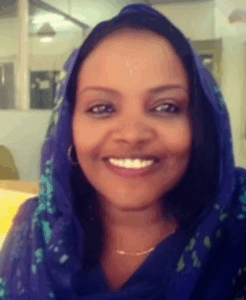
Sulaima Ishaq Moh Elkhalifa
MSc. Counselling and Health Psychology specialization in trauma recovery for children affected with conflict and child talk and trauma-sensitive care. Lead counsellor for childhood trauma; project manager of TORCH (trauma outreach and community healing); program manager for TORCH Regional HUB. Ongoing research in creative art within therapeutic for children affected by war and in need of special protection settings; program planning, implementation, and monitoring for vulnerable women and girls affected by GBV. PhD Candidate in trauma recovery intervention for children affected by conflict and mental health promotion.
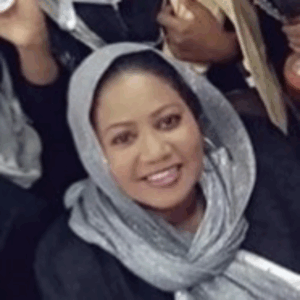
Dr. Muna Abdeen Abdelrahman Mohamed
Ph.D. in Criminal psychology specialization in substance use abuse and addiction. Ongoing researches include addiction among university students at Khartoum State; Post-traumatic stress disorder within the Military; efficacy of cognitive therapy on negative emotions among soldiers. Research interests include the role of forensic psychologist in the prevention of relapse among psychotic patients; Psychological dimension of the crimes committed by the elderly in Sudan.
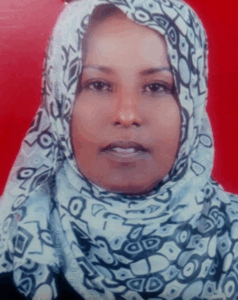
Dr. Souad Mousa Ahmed Bakhet
PhD in Psychology specializing in advocating for counselling psychology. Current research include assessing supportive groups among cancer patients; assessingsuicide preventive protocols in mental health centers in Khartoum State. Ongoing interests include assessing the accessibility of vulnerable women and girls to mental health and primary health care clinics; measuring the psychosocial support systems available chronically ill patients in Khartoum State hospitals; and planning for a culturally-sensitive integrated intervention to support women and girls S/GBV violations.
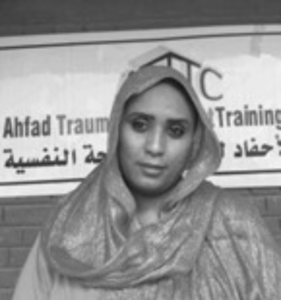
Shima Mohamed Bashir
MSc. Counseling and Health Psychology. Executive Manager, Ahfad Trauma Center, an affiliated in-house and public free counselling service of SoP. Internship Program Supervisor for Master in Trauma and Community Counselling students. Senior psychologist and lecturer at SoP. PhD Candidate of social capital and collective healing as a tool among in low resource settings. Ongoing interests include peace and conflict recovery of refugee communities using trauma-informed care therapies such as Narrative Theatre.
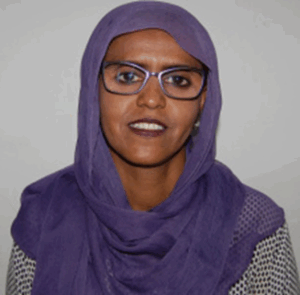
Dr. Nuha Elsadig Ahmed Hussien
PhD in Psychology, specializing in music therapy and establisher of Star Music Psychotherapy Center. A member of the Sudanese Society of Psychology, Omdurman Youth Center, and American Psychological Association. Current research include adolescent mental health and wellbeing with the use of creative arts therapy to alleviate psychosocial distress. Ongoing interests include curriculum and it is role in developing creative thinking for children; the inclusion of disabled children in creative teaching skills; rehabilitation programs for street children; psychosocial and cultural messaging for children with special needs in media.

Dr.Hwiada Mahmoud Abubakar Hassan
Assistant Professor of Medical Anthropology. Editor of Ahfad Journal Women and Change. Interests include Medical Anthropology in Public Health. Recent publications include Partiality and Accountability in Patterning Schistosomiasis Transmission in the Gezira Irrigated Scheme in Sudan (2018); The Transmission Patterns of schistosomiases in Khartoum State, Sudan (2016); Sudan in Arab Family Studies: Critical Reviews (2018). Stigma and the process of deconstruction of the social identity of women living with HIV/AIDs in Sudan (2015).
Manal Mohamed Eltayeb
MSc in Trauma and Community Counseling. Psychologist and lecturer at SoP. Member of the School Board Committee (Quality and Accreditation Chair), member of the research and ethics School Board. Current research interests include assessing protocols and interventions in mental health to scale-up service provision in primary health care and public mental health facilities. Ongoing research include credential evaluation to develop accreditation and licensure procedure for best practices in higher education policies and documentation requirements. PhD Candidate of health psychology and group dynamics for program implementation and intervention in the mental health of schools.
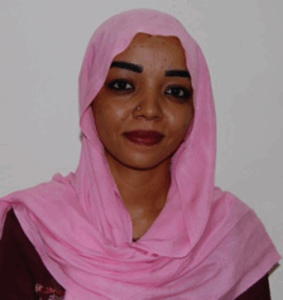
Eman Farah Ahmed Farah
MSc in Trauma and Community Counseling. Childhood Counselor and lecturer at SoP. Regional trainer for psychosocial support programming of internally displaced children living in extreme poverty; psychosocial support for survivors of gender base violence; social reintegration of fistula patients; psychosocial support for children and adolescents in emergency settings. Co-author Minimal Standard of Intervention for children and adolescents in Emergency Settings. Ongoing interests include trauma recovery and upscaling services and treatment using KIDNT intervention to treat traumatized youngsters settled in Jabarona and Nifasha refugee camps.
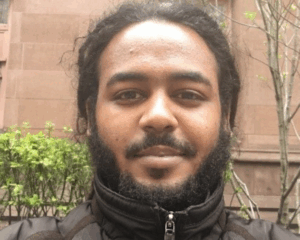
Abdelrahman G. Badri
M.A. in Clinical Psychology, concentration in Trauma and Global Mental Health. Lecturer at SoP. My current research interest centre around understanding local idioms of distress (i.e. how Sudanese youth experience and express psychological distress); development/adaptation of culturally-sensitive assessment tools and psychotherapeutic interventions (i.e. Interpersonal Psychotherapy); acculturation processes of migrant/refugee children and adolescents; scaling-up and dissemination of psychosocial support using tele mental health.
Publications under review: The Case of Eritrean Unaccompanied Refugee Minors in the Sudan.
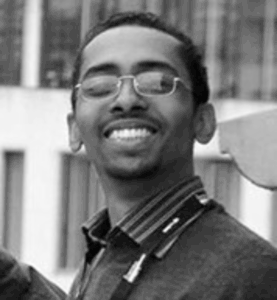
Badri Saad Salih Ibrahim
Lecturer at School of Psychology and Early Childhood Education. Has Masters Degree in Applied Information Technology, Bachelors Degree in Applied Information Technology.
Research interests: Computer Graphics, Animation, Illustration, Narrative Media, Multimedia
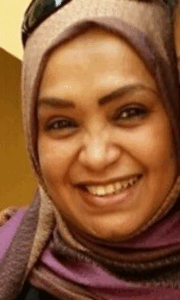
Dr. Aisha Awad Elbalola
Vice Dean for Academic Affairs, School of Psychology & Pre school Education. Has PhD in Psychology, Khartoum University, Master in Counselling & Health Psychology, AUW, Bachelor in Psychology, AUW
Research interests: Couple and families interventions, group therapy, and mental health
Undergraduate Programs
Curriculum
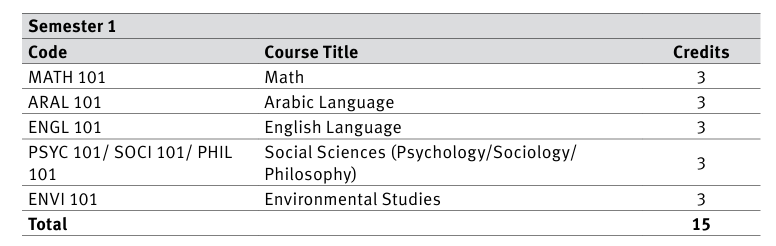
SoP curriculum spans over five academic years. The school follows the semester system (two semesters per year) and, as the laws of the Ahfad University for Women require, each semester will be treated separately in terms of the courses and evaluation of results. Each course is given a course title, course designation, and a load in terms of credit hours. Listed below are the courses that constitute the curriculum, distributed by semesters and academic years.
Semester 1
Semester 2
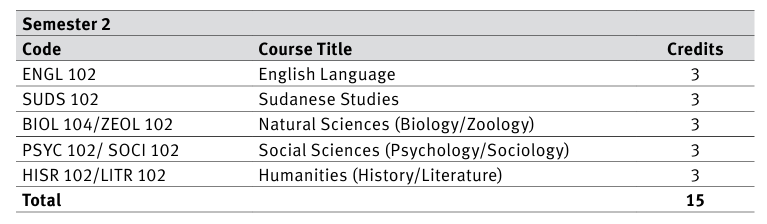
Semester 3
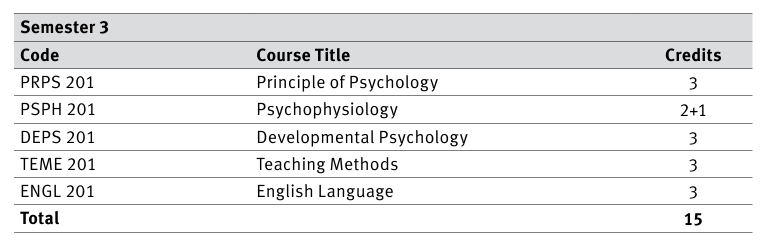
Semester 4
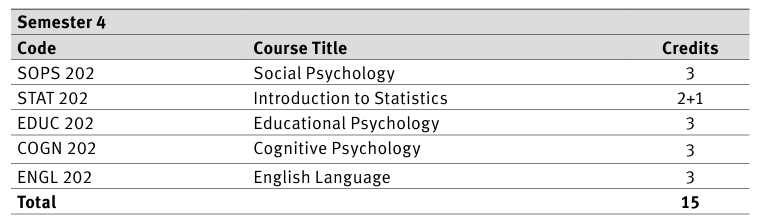
Semester 5
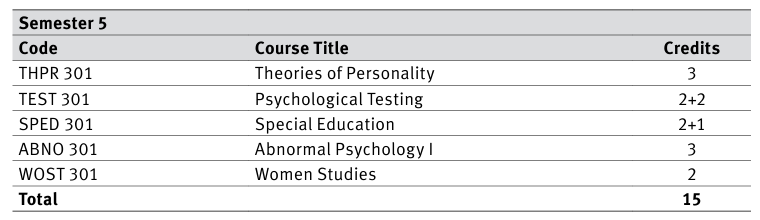
Early Childhood Education (ECE) - Required Courses
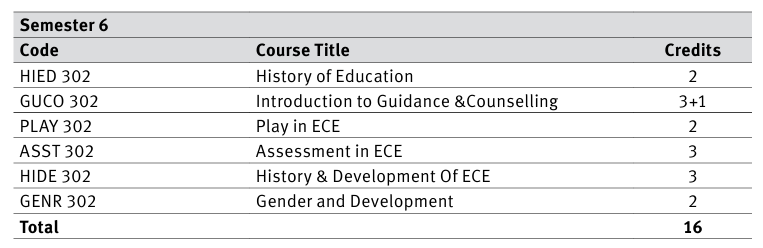
Semester 6
Semester 7
Semester 8
Semester 9

Semester 10
Counseling and Health Psychology (CHP) Required Courses
Semester 6
Semester 7
Semester 8
Semester 9
Semester 10
Course Descriptions
PRPS 201 Principles of Psychology 3 cr.
This course provides the fundamental principles and concepts of understanding human behavior, including emotions, motivate, types of personality, components of intelligence, the different states of awareness, and normal and abnormal behavior.
PSPH 201 Psychophysiology 2+1 cr.
This course introduces second year psychology students to the basic functions of the nervous, endocrine, limbic, and sensory systems.
DEPS 201 Developmental Psychology 3 cr.
This course provides a comprehensive study of the developmental stages of children from conception through early adolescence, including physical, emotional, social and cognitive aspects.
TEME 201 Teaching Methods 3 cr.
This course provides an overall but comprehensive study of the teaching/learning paradigm. This includes the main facts about planning, implementing and assessing instructional activities and gaining confidence in exercising professional judgment through reflective practice.
ENGL 201 English Language 3 cr.
See University required courses.
STAT 202 Introduction to Statistics 3 cr.
This course provides an overall but comprehensive study of statistics including the main facts about collecting and describing data, introducing probability, estimation and evaluation statistics.
EDUC 202 Educational Psychology 3 cr.
This course is designed to promote understanding of the principles that effects the learning process, and the learning environment. This course emphasizes the application of developmental and learning theory to the skills needed in classroom settings.
COGN 202 Cognitive Psychology 2 cr.
This course provides an in-depth exploration of human cognition, focusing on both classic and current issues. The study of cognition relies heavily on experimental research designed to test models and theories of course processes, and will explore both behavioral and neuropsychological approaches to data and theory.
SOPS 202 Social Psychology 3 cr.
The course provides an in-depth investigation into understanding the nature and the causes of the individual’s behavior in social situations. This will include the study of people’s thoughts feelings and actions in relation to one another. As well as understanding the determinants, attributes and motives for the group.
ENGL 202 English Language 3 cr.
See University required courses.
THPR 301 Theories of Personality 3 cr.
This course is designed to provide coverage of the theoretical foundations and theorists’ positions in explaining human behavior emphasizing aspects of personality, motives and the organization of our behavior and mental life. Prerequisite: PRPS 201.
TEST 301 Psychological Testing 2+2 cr.
This course provides a historical overview and contemporary outlook into the aims, nature and applications of psychological testing, including gaining the necessary knowledge, skills, requirements, conditions, and designs of the most used psychological tests.
SPED 301 Special Education 2+1 cr.
This course provides students with the basic concepts of special education in terms of types of disabilities, special education program, and identifying and assessing exceptional children.
WOST 301 Women Studies 2 cr.
See University required courses
HIED 302 History of Education ECE 2 cr.
This course introduces the different historical educational systems and their developments that may aid the planning of the present and future.
GUCO 302 Introduction to Guidance and Counselling 3+1 cr.
This course covers the basic definitions, principles, and goals of guidance in different professional areas, and the theories behind the techniques used. Students will be more acquainted with the ethical implications of this helping profession.
PLAY 302 Play in ECE 2 cr.
This course highlights the relationship between play, development and learning during earlychildhood. Emphasis is on understanding the nature of play, the role of the adult and the environment in facilitating play in early childhood education. Special emphasis is on organizing play activities as curriculum components and as assessment tools in the ECE classroom.
ASST 302 Assessment in ECE 3 cr.
This course is designed to provide a basic understanding of measurement principles and assessment techniques relevant to ECE. Both formal and informal assessment techniques are addressed as a functional part of the ECE process, as well as the meaning of information gained through assessment and evaluation and how to use that information for specifying educational objects.
HIDE 302 History and Development of ECE 3 cr.
This course introduces the different philosophical views, theoretical approaches, and practical application to childhood education, children’s guidance and behaviour control.
GNDV 302 Gender and Development 2 cr.
See University required courses.
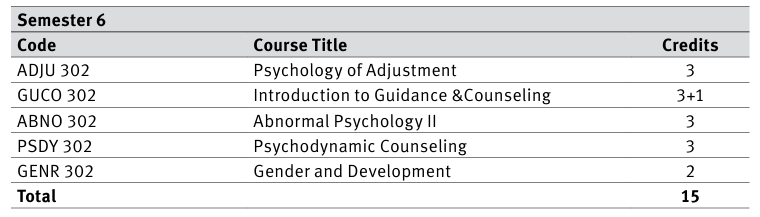
ADJU 302 Psychology of Adjustment CHP 2 cr.
This course involves the theoretical and empirical bases in the study adaptation to situations, models of stress, theories of human nature, psychological disorders, and treatment modalities as well as specific applied focuses on work, relationships, sexuality, social influence, gender roles.
GUCO 302 Introduction to Guidance and Counselling 3 cr.
This course covers the basic definitions, principles, and goals of guidance in different professional areas, and the theories behind the techniques used. Students will be more acquainted with the ethical implications of this helping profession. Prerequisites: THPR 302.
ABNO 302 Abnormal Psychology | 1 3 cr.
This course explores historical views and current perspectives of abnormal and maladaptive behaviors. Major depression and generalized anxiety onset will be the emphasis of this course as well as other anxiety and stress-based disorders.
PSDY 302 Psychodynamic Counselling 3 cr.
This course is designed to provide the theoretical foundations of contemporary psychodynamic assessment, psychotherapy, and counselling. Prerequisites: THPR 302.
GNDV 302 Gender and Development 2 cr.
See University required courses.
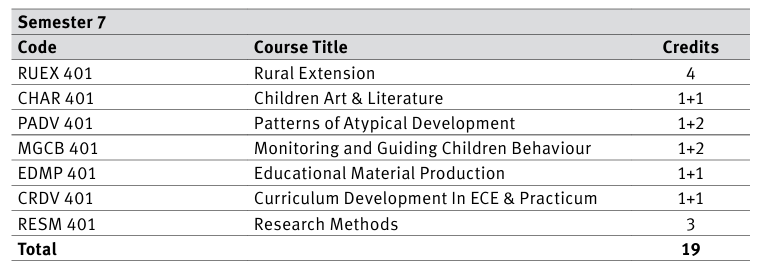
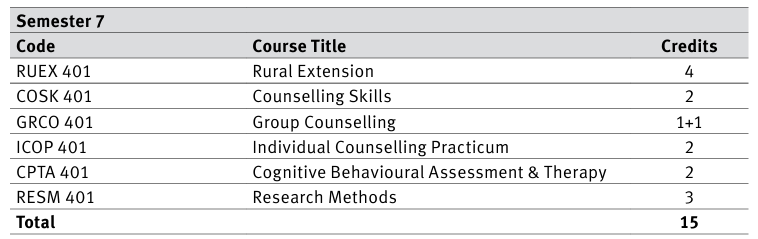
RESM 401 Research Methods 3 cr.
This course provides an introduction to quantitative and qualitative research methodologies and tools. The purpose of this course is to provide students with the knowledge, skills, and techniques of how to conduct a research.
RUEX 401 Rural Extension 4 cr.
See University required courses.
CHAR 401 Children Art & Literature ECE 1+1 cr.
The course provides the scientific and practical knowledge to understand the different kinds of literature given to children, the different stages of artistic development, and the influence of culture on both literature and art activities for children.
PADV 401 Patterns of Atypical Development 1+2 cr.
This course introduces the principles and variables that impact developmental patterns in childhood including biological and psychosocial influences on the developing child with particular emphasis on the development of children with special needs. Course content will primarily address early childhood development 0 – 8.
MGCB 401 Monitoring and Guiding Children Behavior 1+2 cr.
This course is designed to understand and use a wide array of effective monitoring and guiding approaches, strategies and tools to positively influence children’s development and learning based on environmental needs and abilities, as well as the impact of family involvement and cultural influences.
EDMP 401 Educational Material Production 1+1 cr.
The course provides both theoretical base and practical experience in the adaption of local and cultural games to serve as fun educational activities, as well as analytically discussing the purpose and suitability of materials and equipment to the needs of early childhood stages of development for both mainstream and special needs children.
CRDV 401 Curriculum Development in ECE Program 1+1 cr.
The course provides students with the scientific base that enables them to plan and design their own curriculum. Students acknowledge the differences between group and individual guidance, and understand the idea of activity centres and free play.
ABNO 401 Abnormal Psychology II CHP 3 cr.
This course explores major diagnostic categories and criteria, individual and social factors of maladaptive behavior and types of therapy. Categories include substance abuse, sexual deviations, psychosis, and childhood disorders.
COSK 401 Counselling Skills 2 cr.
This course provides students with knowledge, techniques and skills and micro skills on the core conditions to become an effective counselor. Additionally, students are expected to demonstrate and practice what they have acquired in a form of role plays and group work exercises in the client-centered approach to counselling. Prerequisites: GUCO 302.
GRCO 401 Group Counselling 1+1 cr.
This course is designed as an introduction to the use of groups in counselling practice. Specific skills for effective group counseling will be introduced and practiced. Students will be given the opportunity to be a leader and a co-leader, and member in a group.
ICOP 401 Individual Counselling Practicum 2 cr.
The course is designed to help students practically apply the learned counselling skills during the theoretical course. The course includes didactic and experiential class activities, such as role plays and case presentations, counselling experiences with an undergraduate volunteer client, and individual and group supervision. Prerequisites: GUCO 302.
CBTA 401 Cognitive Behavioral Assessment and Therapy 2 cr.
The goals of this course are to provide the theoretical foundations of contemporary cognitive and behavioural assessment and therapy, as well as to understanding the methodology of clinical assessment and practice of cognitive and behavioral therapy.
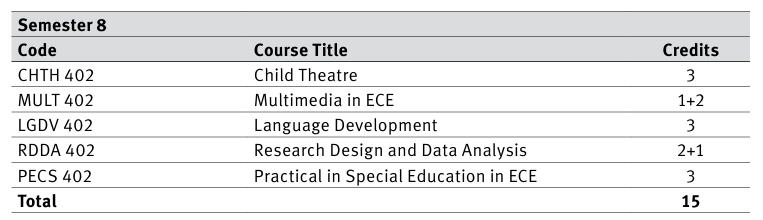
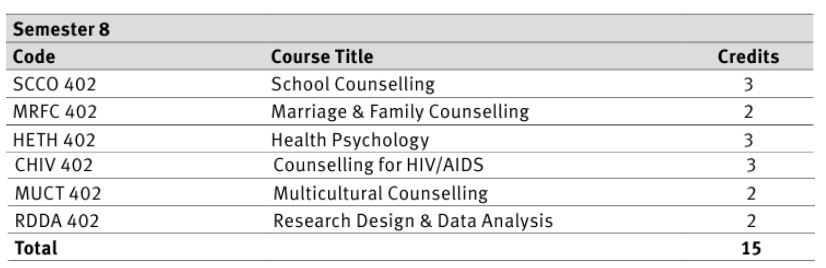
RDDA 402 Research Design & Data Analysis 3 cr.
This course covers social research methodologies such as survey and field research,questionnaire design, analysis of existing data. The course will also introduce students to the safeguards against errors in data collection, data analysis and reporting. In addition, the course will draw the attention of students to ethical issues in social research.
MULT 402 Multimedia in ECE 1+2 cr.
This course will introduce students to the various types of digital multimedia, including digital composition and desktop publishing in theory and with supplementary practical lab-work, so students are familiarized with the digital tools for creating high quality teaching materials for children.
CHTH 402 Child Theatre 1+2 cr.
The course informs students about definitions, characteristics, types and qualifications of those involved in child theatre suiting different age groups of children. Practical experience of writing, directing and acting is a major requirement of the course.
LGDV 402 Language Development 3 cr.
This course introduces students to various theoretical views of language and literacy acquisition. It covers the major components of language and literacy development, methods of studying and assessment, knowledge, skills, and attitudes required to implement a language and literacy program appropriate to different needs.
PECS 402 Practical in Special Education in ECE 3 cr.
This course provides the basic concepts of and historical background to special education programs. Different types of disabilities and the process of identification and assessment of exceptional children are discussed.
SCCO 402 School Counselling 3 cr.
The course provides an overview of theories and techniques of counselling in school settings. Emphasis will be placed upon the counsellor’s role as a facilitator of normal developmental processes to promote academic success, facilitate healthy development. The course is designed to focus on the knowledge base, skills, theories, research, models, and critical issues of school counselling. Current issues facing youth in the contemporary world will also be explored.
MRFC 402 Marriage and Family Counselling 2 cr.
This course will focus on the fundamentals of marriage and family counselling, emphasizing families and couples in intimate relationships, systems of interaction between family members, and unconscious interpersonal conflicts. The course emphasizes family relationships as an important factor in psychological health.
HETH 402 Health Psychology 3 cr.
This course provides an overview of current theory and research linking psychosocial factors to health and disease. It looks at the contribution of psychological theories, principles, and techniques to the promotion of health and the prevention of health-related problems.
CHIV 402 Counselling for HIV/AIDS 3 cr.
This course addresses issues of providing HIV testing and specific counselling skills and techniques. It provides students with knowledge and attitude training on relating with HIV/AIDS clients as they explore their related coping issues such as stigma and isolation.
MUCT 402 Multicultural Counselling 2 cr.
The course is designed to investigate important issues in cross-cultural counselling, including ethnic, racial, and cultural minority differences, barriers to effective cross-cultural counselling, communication and counselling styles.
INTR 501 Internship in ECE 6 cr.
The students will be responsible for both the administrative and the academic aspects of the ECDC/AUW under the supervision of the ECDC staff. Students will be trained in report writing, problem solving, and efficient feedback. This is done through individual observations and weekly group discussions. Prerequisites: HIDE 302; PLAY 302; HIED 302
MGRC 501 Management in Early Childhood Programs 3 cr.
The course focus on informing students about the administrative techniques and characteristic abilities needed to director and promote an early childhood development center.
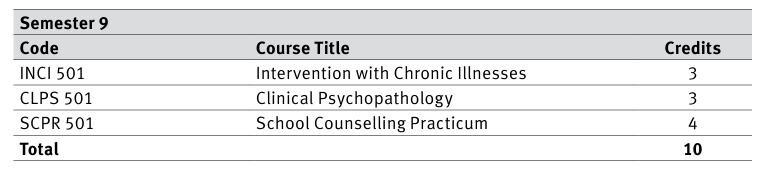
INCI 501 Intervention with Chronic Illness 3 cr.
This course looks into counselling skills specifically needed with chronically ill individuals. Theoretical and conceptual frameworks for viewing chronic illness in the context of individual and family development will be discussed. Examples of multi-level interventions for selected chronic illnesses. Developmental, psychosocial, and cognitive factors related to illness self management will be highlighted.
CLPS 501 Clinical Psychopathology 3 cr.
The course is mainly based on the relation of the two disciplines of psychiatry and clinical psychology. The course introduces the important medico-psychological concepts and terminologies and applies the principles of clinical psychology for case management.
SCPR 501 School Counselling Practicum 4 cr.
This internship enables the students to apply their knowledge of school and adolescents counselling in real settings within primary and secondary schools. Students are required to apply issues related to group counselling, counselling children and teens that address the physical, social and psychological changes and stressors. Prerequisite: SCCO402.
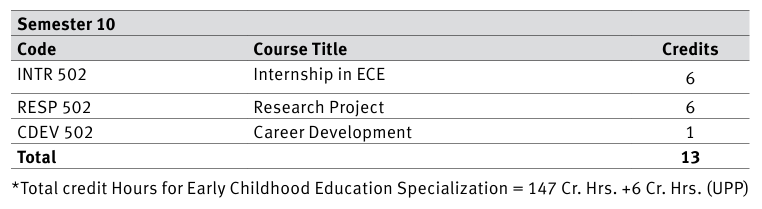
INTR 502 Internship in ECE 6 cr.
Students will spend three days, weekly, in ECDC/AUW. The students will be responsible for both the administrative and the academic aspects of the center under the supervision of the ECDC staff. In other words they become the staff of the center. Students will be trained in report writing, problem solving and meaning of immediate and efficient feedback. This is done through daily basis through individual observations and weekly group discussions. Prerequisites MGCB401; CRDV401.
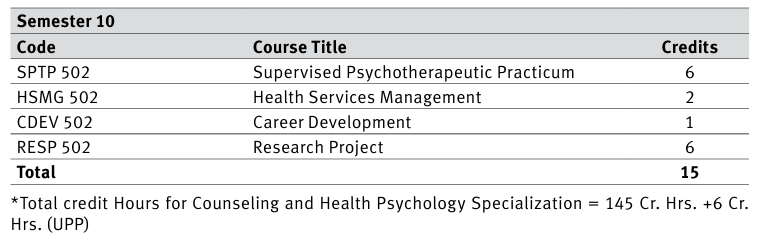
RESP 502 Research Project 6 cr.
See University required courses.
SPTP 502 Supervised Psychotherapeutic Practicum 6 cr.
This course provides an opportunity for students to put psychological theory into practice, in a real world environment setting under close supervision. Students are distributed to the four main mental health units in Khartoum state; a report about the performance of each student is required from the supervisor and should be submitted to the coordinator of the program. Prerequisite: CLPS 501.
HSMG 502 Health Services Management 2 cr.
The content of the course teaches students to think critically about issues which are fundamental to the role of the health services manager in the changing healthcare environment. It looks at the background of healthcare, and explores the new concepts and practice in healthcare management, such as consumer participation, strategic planning and evaluation, information management, and quality control.
CDEV 502 Career Development 1cr.
See University required courses.
Graduation Requirements
Graduation Requirements
The curriculum of the school is designed in a spiral-approach where students are expected to follow theoretical, training, and practical courses according to level. It is very important that students not skip these pre-requisite courses. Each option has 68 credits; for a student to proceed to either ECE or CHP options, she must take and PASS the following pre-requisite courses:
• Principles of Psychology 201
• Developmental Psychology 201
• Educational Psychology 202
• Theories of Personality 301
• Special Education 301
In addition to taking the above pre-requisite courses, the student must successfully complete the study of 143 credit hours including fulfilling her practical training requirements in the following areas related to her option:
• Early Childhood Centers (ECE Option)
• Basic Schools (ECE Option)
• Institutes for children with special needs (ECE Option)
• Centers for the care of patients with chronic diseases (CHP Option)
• Mental Health hospitals (CHP Option)
• Basic and Secondary schools (CHP Option)
• Rural Extension Fieldtrips (ECE & CHP Options)
Postgraduate Programs
Master of Science in Counselling and Health Psychology
Mission
Equip students with knowledge and skills necessary to produce enlightened skillful and qualified counsellors and health psychologists who are capable of tackling multicultural and psychopathological demands of the Sudanese community. In addition, students learn to assess persons in their familial and social contexts, design strategies for change, and evaluate the effectiveness of those interventions.
Vision
Provide high quality education and training in the fields of mental health and counselling psychology
focusing on diverse and multicultural settings.
Admission
July of each year.
Admission Requirements
- This follows the Admission requirements set by the School of Graduate Studies and approved by the University Academic Council.
- Specific requirement is the applicant should hold an honour Bachelor Degree from AUW or an equivalent degree from another recognized institution in Psychology or health related disciplines.
Degree Requirements

Degree Requirements / Curriculum Outline
Semester one
Semester Two
Semester Three

Semester Four

Course Descriptions
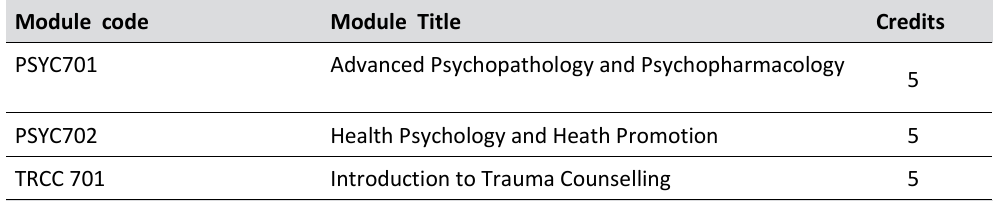
PSYC 701 Advanced Psychopathology and Psychopharmacology 5 cr.
This module covers major psychological disorders aiming to improve clinical skills including the areas of interviewing, assessment, treatment planning, and interventions. I also explores basic application of psychopharmacology for the psychological disorders.
PSYC 702 Health Psychology and Heath Promotion 5 cr.
The module covers the determinants of health behavior; systematically planning and implementing health promotion interventions; evaluating and diffusing these interventions. During the practical sessions, students will work in groups to design an intervention aimed at improving quality of life for individuals leaving with chronic illnesses.
TRCC 701 Introduction to Trauma Counselling 5 cr.
This module provides basic framework for the different TRCC modules. The aim of this module is to provide an understanding of what is trauma, its causes, types, dynamics, consequences and symptoms as well as psychological disorders as reaction to trauma.
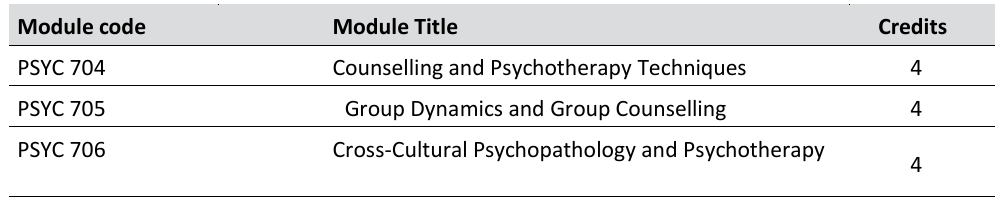
PSYC 704 Counselling and Psychotherapy Techniques 4 cr.
This module examines the basic principles of counselling and psychotherapeutic interventions for the students to acquire counselling skills and techniques and to introduce basic skills like goals and stages of therapy, building therapeutic relationship, and session’s protocols focusing on behavioral and cognitive techniques in therapy.
PSYC 705 Group Dynamics and Group Counselling 4 cr.
This module addresses major concepts, theoretical perspectives, research, professional issues, and skill development related to effective group counselling. The theory, research, and practice of group work, especially group counselling, will be discussed, demonstrated, and practiced.
PSYC 706 Cross-Cultural Psychopathology and Psychotherapy 4 cr.
The module discusses aspects of universal and culture-specific human behavior considering what this implies for psychological theory and application with emphasis on research and theory that is applicable to the diagnosis and treatment of psychological disorders and to the improvement of the delivery of services.
PSYC 720 Ethics in Clinical Settings 3 cr.
The module provides the concepts and principles of ethics in relation to training and practice of counselling, clinical psychology and health settings. The students will explore social and ethical issues that often arise when providing counselling and mental health care to clients over the life span. They will critically reflect on and analyze the ethical challenges and social factors that influence the provider patient/ client relationship within the Sudanese content.
PSYC 721 Advanced Research Methods 4 cr.
This module provides an introduction to different types of quantitative and qualitative research methods. It begins with a focus on defining research problems and processes. Then it explores a range of research designs and methodological techniques that are available for empirical research. In addition, computer skills related to statistical package of social sciences will also be covered.
PSYC 722 Individual Study Unit 4 cr.
This module is designed to build on students’ understanding of what constitutes proper scientific writing. At this stage, the Master’s students will address issues of correct procedural scientific research writing through case studies, assessment of journals’ published papers, in class presentations and reports. Students will be able to use the PC labs to undertake search skills as well as learn how to apply ‘endnote’ program.
PSYC 723 Internship 9 cr.
This is a four months internship aims to equip students with practical clinical skills for the application in mental health setting which includes interviewing, assessment, treatment planning, and intervention using role plays and case vignettes. Students will apply counselling skills and health promotion intervention approaches with individuals living with chronic illnesses including cancer, HIV, diabetes and renal failure.
Master of Arts in International and Multicultural Education and Development
Mission
To graduate enlightened, appreciative, qualified and socially committed cadres with enquiring and critically thinking minds who are capable of tackling problems of education and development in a multi ethnic and multicultural society.
Vision
To provide a challenging graduate education that is organically integrated with research which will be a strong driving force for the social and economic development of a peaceful and democratic society.
Admission
July of each year.
Admission Requirements
• This follows the Admission requirements set by the School of Graduate Studies and approved by the University Academic Council.
• Specific requirement is the applicant should hold an honour Bachelor Degree from AUW or an equivalent degree from another recognized institution in social or natural sciences, law, education, art, media, or other related disciplines.
Degree Requirements

Degree Requirements / Curriculum Outline
Semester one
Semester Two
Semester Three

Semester Four

Course Descriptions
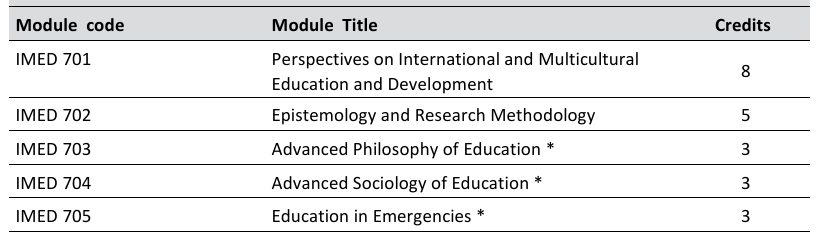
IMED 701 Perspectives on International and Multicultural Education & Development 8 cr.
In this module, students will be working with pedagogical and social science themes from a multicultural, international and development perspective. Students will develop their skills in applying various theoretical perspectives when working with different academic subjects to ensure a comprehensive inter-disciplinary breadth as well as developing further competence based on previous education.
IMED 702 Epistemology and Research Methodology 5 cr.
This module aims at examining the nature and interpretation of knowledge. It introduces students to various research traditions with a view to understanding the relationship between research traditions and epistemology (generation of knowledge).
IMED 703 Advanced Philosophy of Education 3 cr.
This module is intended to help students develop their ability to apply methods of philosophical analysis to educational issues. This will include development of philosophical thinking such as clarity of expression, critical reflection, and justification of claims and notions of cogency, coherence and consistency.
IMED 704 Advanced Sociology of Education 3 cr.
The module covers the relationship between the sociology of education and educational politics, policy and public debate. It also focuses on the effect of poverty on educational experience and performance within communities and on the state responses to such conditions. Students will grasp the major sociological perspectives to improve their understanding and assessment of how the educational systems actually operate.
IMED 705 Education in Emergencies 3 cr.
This course helps students to think effectively in educational approaches that suit the situations of those disadvantaged groups affected by crisis (natural disasters or war/conflict and violence) and how these groups’ educational needs and rights are fully met and satisfied. Moreover, strategies of enhancing, strengthening and promoting global knowledge and capacity will be worked out.
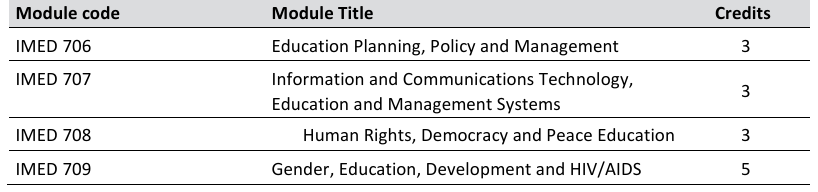
IMED 706 Education Planning, Policy and Management 3 cr.
This module covers international trends in educational planning, leadership, management and governance. It aims to equip students with the knowledge and skills needed to analyze , plan and manage educational changes, innovations or reforms.
IMED707 Information & Communications Technology, Education & Management Systems 3 cr.
This module critically explores the role of ICTs in teaching and learning introducing the educational technology and current research on critical issues, trends, diffusion and adoption of technology and history and theoretical foundations of the field. Students will identify, develop and apply a variety of technological skills congruent to their educational technology philosophy.
IMED 708 Human Rights, Democracy and Peace Education 3 cr.
This module examines international debates on human rights, peace, democracy and social justice. It further explores how the principles and values of human rights are linked to the concepts of conflict resolution, peace, democracy, good governance and education. Moreover, the issues of gender, development and HIV/Aids are cross cutting in this module.
IMED 709 Gender, Education, Development and HIV/AIDS 5 cr.
The module is intended to provide an understanding of the HIV/AIDS context in Africa with special emphasis on Sudan. It examines the relationship between social identity and gender, development, and HIV/AIDS.
IMED 720 Thesis Preparation 9 cr.
This thesis module is a preparatory one where the students should present their proposals and meet their supervisors to settle the research topics. The topics should be related to the thematic issues in the program, and if at all possible, should have a direct relevance for the student’s place of work.
IMED 799 Thesis 9 cr.
The fieldwork is the basis for the writing of the thesis and after submission students will have their oral examinations.
Master of Science in Trauma and Community Counselling
Mission
To qualify students to practice the counselling skills and therapeutic procedures in the delivery of services to individuals, families and communities affected by traumatic events. The program prepares students to conduct high quality research in the area of trauma and community counselling.
Vision
The program aspires to provide comprehensive trauma counselling educational and training programs to qualify graduates in delivering optimum care to individuals and communities at national and regional levels.
Admission
July of each year.
Admission Requirement
• This follows the Admission requirements set by the School of Graduate Studies and approved by the University Academic Council.
• Specific requirement is the applicant should hold an honor Bachelor Degree from AUW or an equivalent degree from another recognized institution in social or natural sciences.
Degree Requirement

Degree Requirements / Curriculum Outline
Semester one
Semester Two
Semester Three

Semester Four

Course Descriptions
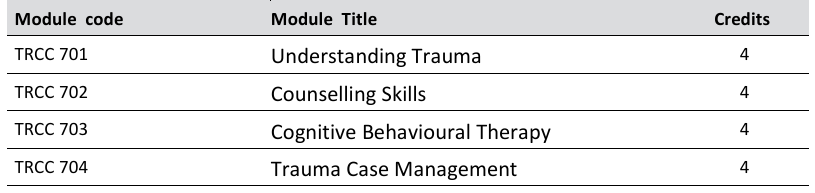
TRCC 701 Understanding Trauma 4 cr.
The aim of this module is to provide an understanding of what is trauma, its causes, types, dynamics, consequences and symptoms as well as psychological disorders as reaction to trauma.
TRCC 702 Counselling Skills 4 cr.
The module is designed to help students practically apply counselling skills with individuals and communities subjected to traumatizing events. Developing counselling practice skills using narrative approaches and critical reflection will be emphasized. The module includes didactic and experiential class activities, such as role plays and case presentations.
TRCC 703 Cognitive Behavioral Therapy 4 cr.
The module is designed to help students practically apply cognitive behavioral therapy (CBT) which is problem-focused psychosocial intervention in relation to stress related disorders including Posttraumatic stress disorder (PTSD). The module includes didactic and experiential class activities, such as role plays and case presentations.
TRCC 704 Trauma Case Management 4 cr.
This module is a combination of knowledge and practical experience in the field of trauma case management and it is aiming to equip students with the knowledge and skills they need to thoroughly identify, assess, treat and rehabilitate various trauma cases.
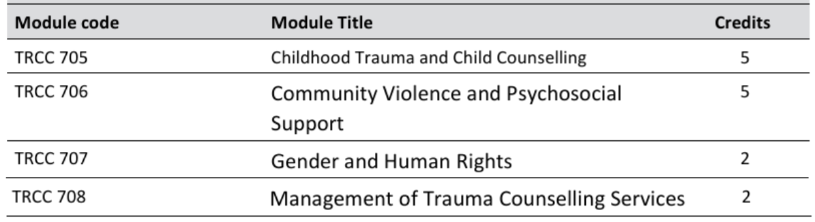
TRCC 705 Childhood Trauma and Child Counselling 5 cr.
This module aims to provide the student with comprehensive understanding to various types of Childhood trauma with skill based training in counselling of children and youngsters who had undergo traumatizing events or incidents individually or within their communities. To explore the different psychological disorders that might be associated to trauma experiences and introduce specialized Trauma Focused Counselling for children.
TRCC 706 Community Violence and Psychosocial Support 5 cr.
This module aims to introduce the students to the field of community trauma with a comprehensive overview of the nature of the traumatic events, and their bio-psycho-social and cultural impact. This multi-systemic or ecological approach combines clinical and community oriented perspectives in the assessment and planning of intervention strategies with groups and communities.
TRCC707 Gender and Human Rights 2 cr.
This module aims to provide students with an overview of major Human Rights treaties and resolutions carried out by the United Nations and particularly concerns with women rights, child rights and the Sudanese legislations that protects individuals and communities subjected to violence and violations.
TRCC708 Management of Trauma Counselling Services 2 cr.
This module is a practical experience in the field of trauma care services and it is aiming to equip students with the administrative and organizational skills needed to thoroughly register, assess, document, refer follow-up and evaluate various trauma cases.
TRCC720 Advanced Research Methods 4 cr.
This module provides an introduction to different types of quantitative and qualitative research methods. It begins with a focus on defining research problems and processes. Then it explores a range of research designs and methodological techniques that are available for empirical research. In addition, computer skills related to statistical package of social sciences will also be covered.
TRCC799 Master Clinic 5 cr.
This module provides the students with on-hands training of the skills, tools, and techniques required to deal with trauma cases. The students will practice at the Ahfad Trauma Center.
TRCC799 Thesis 6 cr.
The fieldwork is the base for writing the thesis. The thesis should be related to the thematic issues in the program, and if at all possible, should have a direct relevance for the student’s field of specialization.
Doctor of Philosophy in Psychology
About
The program PhD in Psychology was launched in 2007. The program is research based aimed to graduate skilled psychologists to assume responsibilities in research, advisory, consultancy, management and university teaching.